Loading Dock Safety Checklist: What OSHA Actually Requires at the Dock
A checklist for every trailer, every shift and every week, with the OSHA section behind each line. Plus the parts most dock safety pages get wrong: who has to chock the wheels, when a dock edge needs a guardrail, and why a crowded dock is a dangerous dock.


Loading dock safety comes down to three things: the trailer cannot move while anyone is in it, nothing and nobody goes off the dock edge, and forklift drivers and pedestrians can see each other. OSHA has no single loading dock standard. The rules are spread across five sections of 29 CFR 1910, covering forklifts, dockboards, fall protection, walking surfaces and clearances. The checklist below gathers them in one place and tags each line with the section it comes from, or marks it as best practice where no rule applies.
Two things you will not find here. The first is the claim that "25% of warehouse accidents happen at the loading dock". It is on almost every dock safety page, and we could not trace it to any dataset. The second is a blanket statement that "OSHA requires wheel chocks". The real rule is more interesting than that, and it matters if you ever have to explain an incident.
What does OSHA require at a loading dock?
OSHA requires five things at the dock. Trailers are secured before a forklift drives in. Dockboards are strong enough and fixed in place. Edges 4 feet or higher are protected where people could fall. Floors are kept clear. Forklift operators are trained and evaluated. Here is where each rule lives.
| Topic | What the rule says | Section |
|---|---|---|
| Securing the trailer | Brakes set and wheel chocks under the rear wheels before a forklift boards a highway truck; wheel blocks in place while loading or unloading. | 1910.178(k)(1), (m)(7) |
| Uncoupled trailers | Fixed jacks may be needed to stop a semitrailer from upending when it is not coupled to a tractor. | 1910.178(k)(3) |
| Dockboards and levelers | Rated for the load, secured so they cannot shift, with run-off protection (for dockboards in service from January 2017) and the vehicle prevented from moving while people are on the plate. | 1910.26(a)–(d); 1910.178(n)(11) |
| Dock edges | Edges 4 feet or more above a lower level need a guardrail, safety net or personal fall protection, with a limited exception for the working side of a loading dock. | 1910.28(b)(1), (b)(4) |
| Floors and surfaces | Kept free of spills, loose boards, snow and ice; inspected regularly and as necessary; hazards fixed or guarded before use. | 1910.22(a), (d) |
| Clearances | Safe clearance at loading docks, doorways and turns, with signs where clearance is limited. | 1910.176(a), (e) |
| Lighting | Where general lighting is below 2 lumens per square foot, the forklift needs its own directional lights. | 1910.178(h)(2) |
| Forklift training | Every operator trained and evaluated before driving, and re-evaluated at least once every three years. | 1910.178(l)(1), (l)(4)(iii) |
The full texts are short and worth reading: 1910.178[1], 1910.26[2], 1910.28[3], 1910.22[4] and 1910.176[5]. States that run their own OSHA plan can set stricter rules, so check your state plan if you are not under federal OSHA. The forklift standard is also one of OSHA's most-cited: number 7 on the preliminary list for fiscal year 2026.[6]
What causes most loading dock accidents?
Most serious dock accidents involve a forklift and a trailer that moves, an edge nobody protected, or a pedestrian the driver did not see. The usual patterns are:
- Trailer creep. Every time a loaded forklift drives in and out, the trailer is pushed a little away from the dock, until the gap is wide enough for a wheel to drop. Dropped trailers on landing gear are more prone to it than trailers still coupled to a tractor.
- Early departure. The driver pulls away while a forklift is still inside the trailer or on the dock plate. It usually happens when nobody told the driver loading was not finished.
- Driving off the dock edge. A forklift reverses off an open door with no trailer behind it, or off the side of the dock.
- Pedestrians struck by forklifts. Drivers, checkers and lumpers walking in the forklift lane, often near the door where visibility is worst.
- Dockboard and trailer floor failures. A plate that shifts or is overloaded, or a rotten trailer floor that gives way under a loaded forklift.
The sample dock safety program in OSHA Region V's emphasis program for powered industrial vehicles describes trailer creep in exactly those terms and notes that "spotted trailers (dropped trailers) are more susceptible to trailer creep".[7] The same document quotes NIOSH: of 1,021 U.S. forklift deaths between 1980 and 1994, 22% were overturns, 20% were workers on foot struck by a forklift and 9% were falls from the forklift. A 2019 Bureau of Labor Statistics fact sheet counts 614 forklift deaths from 2011 to 2017, including 11 falls to a lower level and 9 deaths in pedestrian vehicular incidents in 2017 alone.[8]
What does not exist is a national count of accidents at loading docks. BLS does not code injuries by "loading dock", so any percentage you see for that is an estimate without a traceable source. The patterns above are enough to plan from.
Does OSHA require wheel chocks at the loading dock?
Yes, the text of the forklift standard requires them: "The brakes of highway trucks shall be set and wheel chocks placed under the rear wheels to prevent the trucks from rolling while they are boarded with powered industrial trucks."[1] In practice, though, OSHA has interpreted that rule in three ways that change what you actually have to do.
- For commercial trucks, the FMCSA rule takes over, even at your dock. In a 2011 interpretation letter OSHA said that Federal Motor Carrier Safety Administration rules on parking brakes "preempt OSHA chocking requirements with respect to CMVs" (commercial motor vehicles, the trucks and trailers carriers bring to your dock).[9]
- But your forklift drivers still may not board an unsecured trailer. The same letter says an operator "must be trained that he or she is not to operate a PIT on a trailer that has been backed to a company's dock, unless the trailer is properly secured or restricted from movement prior to boarding." (PIT is OSHA's term for a forklift.) Training your operators is your job, not the carrier's.
- Dock locks count. Since 1981 OSHA has allowed a mechanical device that secures the trailer to the dock, such as a dock lock, in place of chocks when it provides "the equivalent protection of wheel chocks".[10]
The practical rule: the trailer is secured, with a chock or a restraint, before the first forklift goes in, and somebody at your site checks it. Who sets the chock can be agreed with carriers. Whether it is set before boarding is on you.
Wheel chocks or vehicle restraints: which should you use?
Use vehicle restraints on the doors that handle most of your traffic, and keep chocks at every door as the backup, because each one fails in situations where the other works.
| Wheel chocks | Vehicle restraint (dock lock) | |
|---|---|---|
| How it works | A wedge in front of a rear wheel stops the trailer from rolling forward. | A hook on the dock face grabs the trailer's rear impact (ICC) bar. |
| Who sets it | Driver or dock worker, walking out between trailers. | Dock worker, from inside, with a button. |
| Where it fails | Slips on ice, gravel or oil; gets forgotten; set on the wrong wheel. | Damaged or missing ICC bars, lift gates, lowboy trailers. |
| Visible from inside? | No, unless paired with a sensor or light. | Usually, via lights inside and outside. |
| Best for | Low-volume doors, yards, and as the backup at every door. | High-volume doors, dropped trailers, sites with frequent forklift traffic into trailers. |
The same trade-offs appear in OSHA's Region V program: chocks "can sometimes slip", setting them means "requiring people to walk in between trailers", and ICC bar systems "may not work with damaged ICC bars, lift gates, and low-boy trailers".[7] Whatever you use, add a dock light at each door: red outside and green inside while someone is in the trailer, so the truck driver knows not to move and the forklift operator knows the trailer is secured.
Does a loading dock edge need a guardrail?
Under federal OSHA, any edge 4 feet or more above a lower level needs a guardrail, safety net or personal fall protection.[3] Most dock platforms are about that height, so the question comes up at almost every warehouse.
There is an exception for the working side of a loading dock, where a guardrail would stop the work. It applies only where the employer can show fall protection is not feasible, while loading is in progress, and to authorized employees trained under 1910.30. The sides of the dock and open doors with no trailer behind them are not the working side, so a chain, gate or barrier across an empty door is the simple fix.
Dockboards have their own rule: a person on a dockboard must be protected from a 4-foot fall by a guardrail or handrails. The exception is for plates used only by motorized equipment such as forklifts, where the drop is 10 feet or less and the operators are trained under 1910.30.[3] Dockboards put in service since January 2017 also need run-off protection, such as raised curbs on the sides.[2]
What should a loading dock safety checklist include?
A useful dock checklist follows the order of work: before a forklift enters the trailer, during loading, at release, and recurring equipment checks. "Best practice" marks lines no rule sets.
Before anyone enters the trailer
| Check | Basis | |
|---|---|---|
| Trailer brakes set; trailer chocked or locked by the vehicle restraint | 1910.178(k)(1), (m)(7) | |
| Dropped trailer: landing gear sound, jack stand under the nose if needed | 1910.178(k)(3) | |
| Dock light shows red outside and green inside | Best practice | |
| Dock leveler or plate in place, secured and rated for forklift plus load | 1910.26(a)–(c); 1910.178(n)(11) | |
| Trailer floor checked for holes, rot and debris; forklift lights work if the trailer is dark | 1910.178(m)(7), (h)(2) | |
| Driver checked in and in the waiting area or cab, keys controlled if that is your policy | Best practice |
During loading and unloading
| Check | Basis | |
|---|---|---|
| Forklift drives over the plate slowly, within the plate's rated capacity | 1910.178(n)(11) | |
| Pedestrians kept out of the forklift lane at the door; walkways marked | 1910.176(a); best practice | |
| Dock floor clear of shrink wrap, broken pallets, spills, snow and ice | 1910.22(a) | |
| Trailer position checked for creep on long loads, especially dropped trailers | Best practice | |
| Only trained, evaluated operators on forklifts | 1910.178(l)(1) |
Releasing the trailer
| Check | Basis | |
|---|---|---|
| Forklift out of the trailer and off the plate; leveler stored | Best practice | |
| Dock door closed, or a barrier across the open door | 1910.28(b)(1) | |
| Restraint released or chocks removed by the person responsible | Best practice | |
| Dock light switched to green outside; driver told in person or by the system that loading is finished | Best practice |
Per-shift and periodic checks
| Check | Basis | |
|---|---|---|
| Levelers, restraints and dock lights tested at the start of each shift | 1910.22(d) (levelers); manufacturer | |
| Chocks at every door, undamaged, on a chain or holder | Best practice | |
| Dock edges painted or marked; bumpers present and not torn | Best practice | |
| Forklifts given a pre-shift check; unsafe trucks taken out of service | 1910.178(q)(7), (p)(1) | |
| Clearance signs at low doors; aisles at the dock kept clear | 1910.176(a), (e) | |
| Operator evaluations up to date (at least every three years) | 1910.178(l)(4)(iii) |
OSHA does not set a fixed inspection interval for levelers or restraints; the walking-surfaces rule says "regularly and as necessary". Follow the manufacturer's schedule for the equipment itself.
How does dock scheduling make a loading dock safer?
Dock scheduling spreads trucks across the day, so the dock is not full of forklifts racing to empty five trailers at once while drivers stand around waiting. These accidents get more likely when people hurry: a chock gets skipped, a driver pulls away before anyone cleared the trailer, a pedestrian cuts through the forklift lane.
Waiting has a safety cost outside your fence too. The American Transportation Research Institute found drivers were detained at 39.3% of stops in 2023, and that detained trucks drove 14.6% faster on average than trucks that were not.[11] The U.S. DOT Inspector General estimated that 15 more minutes of average dwell time raises the expected crash rate by 6.2%.[12] Nobody has measured how much scheduling cuts dock injuries, and we will not invent a number. What it changes is concrete:
- You know which trucks arrive in the next hour, so you staff the doors before the trucks get there, not after.
- Each truck gets a door and a time, so drivers do not circle the yard or back into the wrong door.
- Live loads and drop trailers are planned separately, so dropped trailers get their jack stands and creep checks.
- Arrival, start and finish are recorded for each truck, which gives you a record of when the trailer was released if something does go wrong.
The steps in our warehouse receiving process guide fit around this checklist: check-in, door assignment, unloading, release. If you mix live loads and drop trailers, plan them on separate doors where you can, because the safety steps are different. Waiting trucks also cost money: truck detention usually starts after two hours of free time.
LoadingCalendar gives carriers a branded booking portal to book their own slots, shows every door's appointments on one calendar, and records arrival, start and finish for each truck. It costs $99 a month flat, with a 14-day trial and no card required. Our dock scheduling guide walks through setting up slots, doors and carrier bookings.
Who is responsible for loading dock safety: the warehouse or the carrier?
The warehouse is responsible for its own employees, its dock, its equipment and its forklift operators, and that covers most of the checklist. The carrier is responsible for its truck and its driver on the road, including parking brakes under FMCSA rules.
The gray area is the handover. Agree in writing who chocks, who keeps the keys, where drivers wait, and whether drivers are allowed on your dock at all. If a third-party crew unloads, the same rules apply to them. Our guide to lumper fees explains how those crews usually work. Then put those rules in the instructions carriers see when they book, so the driver knows them before arriving.
Frequently asked questions
Sources
- OSHA, 29 CFR 1910.178, Powered industrial trucks: (h)(2) lighting, (k)(1) brakes and wheel chocks, (k)(3) fixed jacks, (l) operator training and evaluation, (m)(7) wheel blocks, (n)(11) dockboards, (p)(1) removal from service, (q)(7) daily examination. osha.gov
- OSHA, 29 CFR 1910.26, Dockboards: capacity, run-off protection, securing, preventing vehicle movement. osha.gov
- OSHA, 29 CFR 1910.28, Duty to have fall protection and falling object protection: (b)(1) unprotected edges of 4 feet or more and the loading dock exception, (b)(4) dockboards. osha.gov
- OSHA, 29 CFR 1910.22, Walking-working surfaces: general requirements and inspection. osha.gov
- OSHA, 29 CFR 1910.176, Handling materials, general: clearances at loading docks and clearance signs. osha.gov
- OSHA, Top 10 Most Frequently Cited Standards, fiscal year 2026 (preliminary, October 2025 to August 2026): powered industrial trucks at number 7. osha.gov
- OSHA Region V, Regional Emphasis Program for Powered Industrial Vehicles, CPL 04-05-2305 (effective October 2023): trailer creep, chock and ICC-bar restraint limitations, sample dock safety program; quotes NIOSH Alert 2001-109 (1,021 forklift deaths, 1980–1994). osha.gov
- U.S. Bureau of Labor Statistics, "Occupational Injuries, Illnesses, and Fatalities Involving Forklifts" (June 2019, 2017 data): 614 deaths 2011–2017; 2017 events by type. bls.gov
- OSHA standard interpretation, letter to Ron Cole (7 March 2011): FMCSA preemption of chocking for commercial motor vehicles; operator training on unsecured trailers. osha.gov
- OSHA Instruction STD 1-11.7 (5 August 1981): mechanical means of securing trucks to a loading dock accepted where they give protection equivalent to wheel chocks. osha.gov
- American Transportation Research Institute (ATRI), "Costs and Consequences of Truck Driver Detention: A Comprehensive Analysis" (September 2024): detention at 39.3% of stops in 2023; detained trucks drove 14.6% faster on average. truckingresearch.org
- U.S. Department of Transportation, Office of Inspector General, report ST2018019 (31 January 2018): a 15-minute increase in average dwell time raises the expected crash rate by 6.2%. oig.dot.gov
This checklist is a practical summary, not legal advice. Federal OSHA rules are quoted as published; state plans and your equipment manufacturer's instructions may add requirements.
You might also like
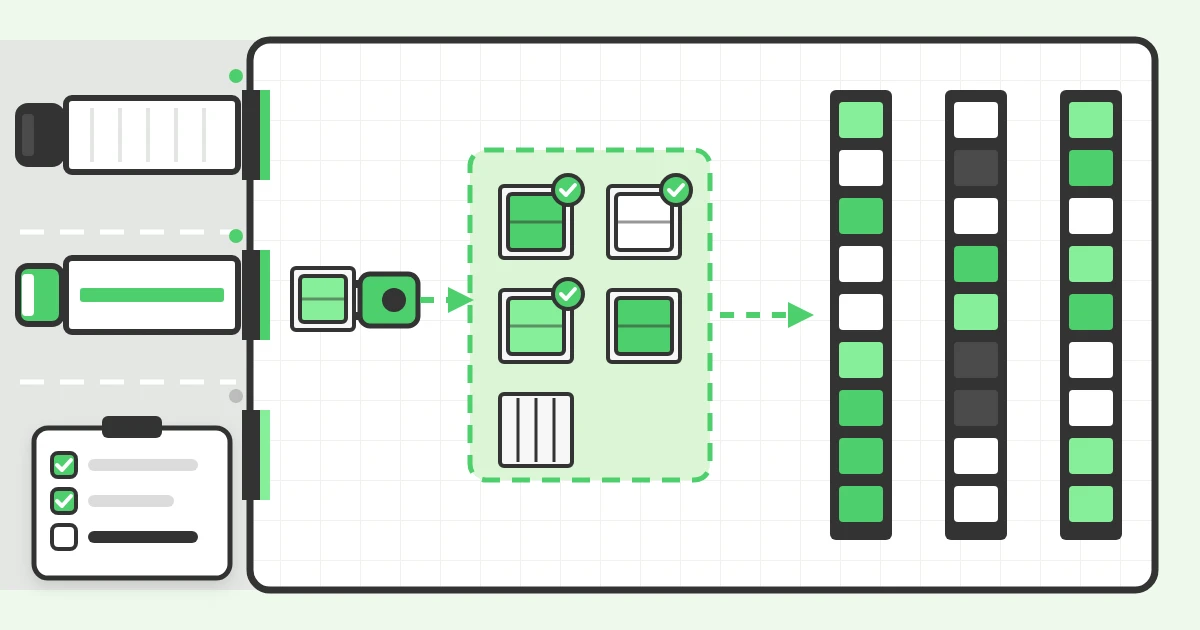
The warehouse receiving process step by step, from booking the truck to putaway. Where receiving breaks, what we recommend and a receiving checklist.
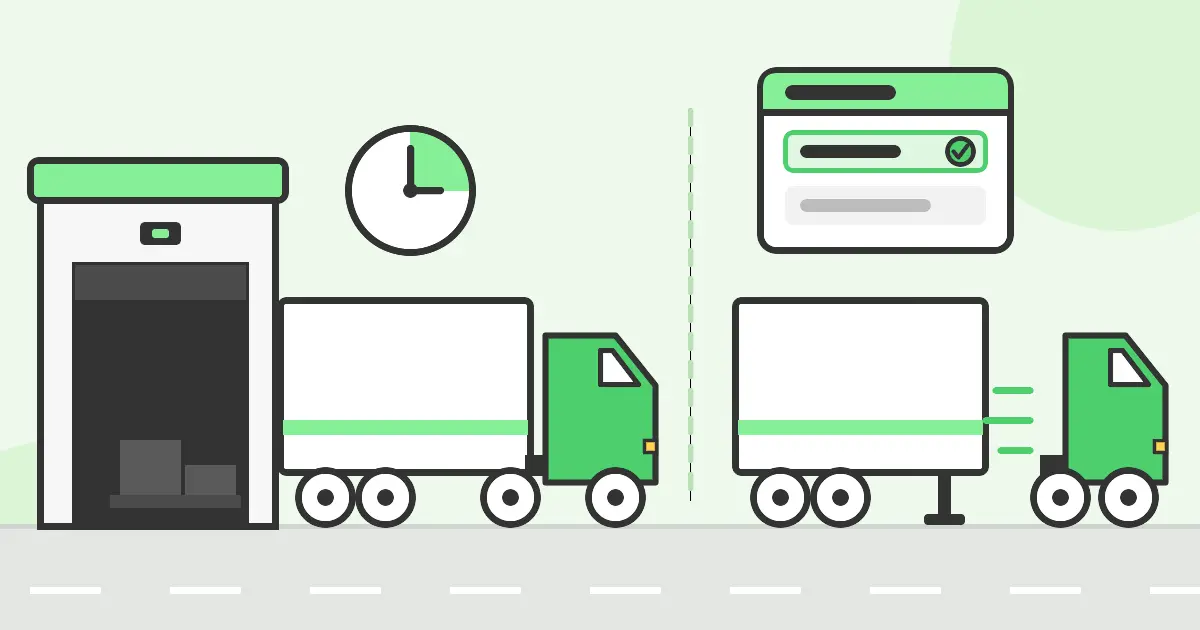
Live load vs drop trailer (drop and hook) from the warehouse side: how each works, detention risk, hidden drop costs and how to schedule both at your dock.
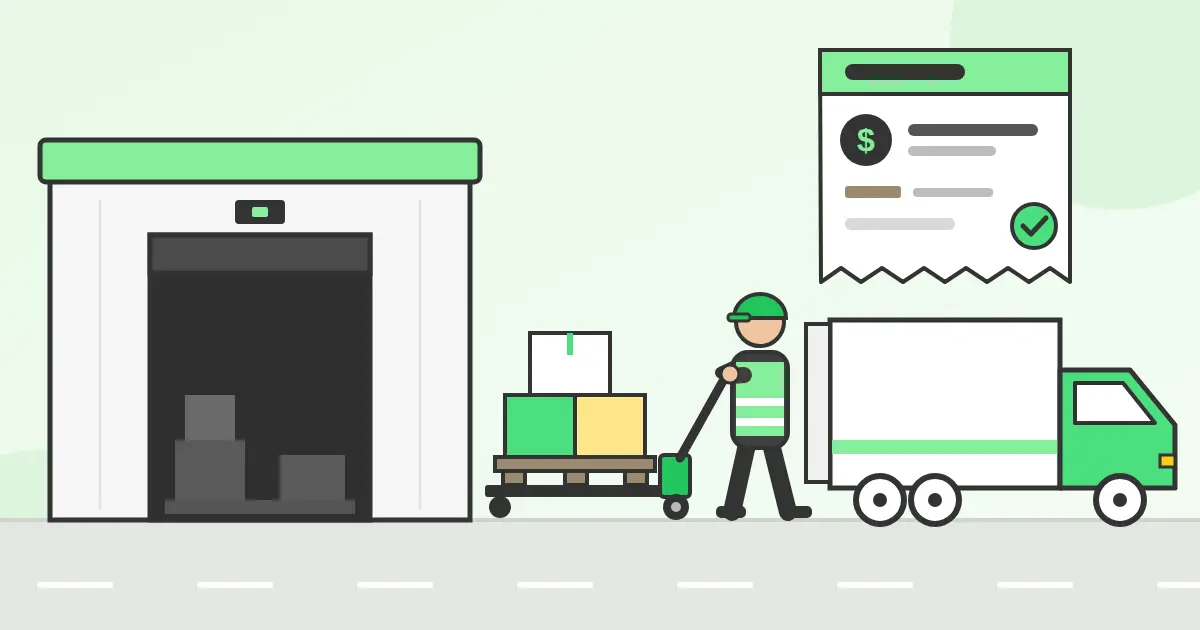
A lumper fee pays third-party workers to unload a truck at the receiver's dock. What it costs, who pays by law and in practice, and how to keep it fair.
Ready for simpler warehouse scheduling?
Join warehouse teams across the world that replaced spreadsheets and phone calls with simple dock appointment scheduling software.
Start My Free Trial 14-day free trial · No credit card required · Cancel anytime