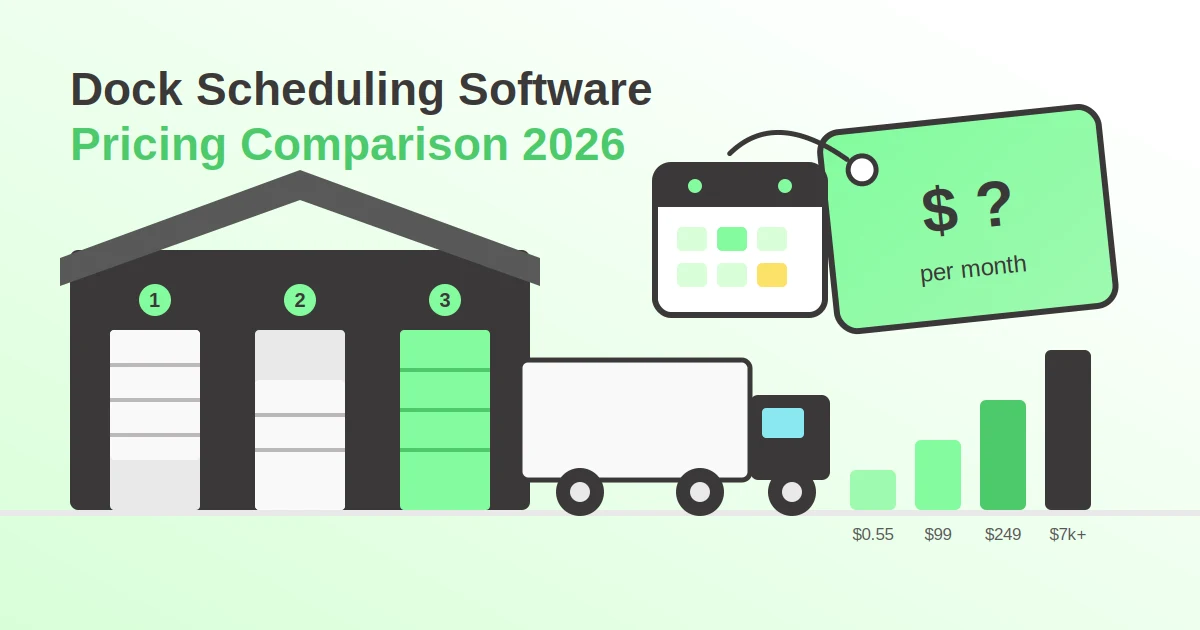
Dock scheduling software costs anywhere from about $0.55 per booking (Cargoclix, priced at €0.50) to $15,000+ per year for enterprise platforms. LoadingCalendar is $99/month flat with unlimited docks, users, and warehouses. Most mid-market tools sit between $175 and $250/month, and the big North American platforms like Opendock start around $6,000–$7,000 per facility per year.
The hard part isn't the range — it's that most vendors don't publish their prices at all. Of the nine tools compared below, only four show a number on their website. The rest require a demo call before you learn what you'd pay. This article pulls together every published price and every credible third-party figure, with a source for each, verified in July 2026.
How much does dock scheduling software cost in 2026?
Here is every major dock scheduling tool with its starting price, pricing model, and where the number comes from. All figures checked in July 2026.
| Software | Starting price | Pricing model | Public pricing? | Free trial | Source |
|---|---|---|---|---|---|
| Cargoclix SLOT | €0.50 per booking (~$0.55) | Pay-per-booking, no monthly fee | Yes | — | [1] |
| LoadingCalendar | $99/month | Flat rate — unlimited docks, users, warehouses | Yes | 14 days, no credit card | [2] |
| GoRamp | From $175/month | Usage-based; scales with docks and modules | Partially | Yes | [3] |
| DataDocks | From ~$249/month | Flat-rate subscription; final price by quote | No — third-party listed | Demo only | [4] |
| Opendock | ~$6,000–$7,000+/year per facility | Annual license per location; quote-based | No | Demo only | [5] |
| Conduit | From $149/facility/month | Per-facility monthly, modular (scheduling, check-in, yard) | Yes | Demo only | [6] |
| C3 Reservations | Quote only | Usage-based, per-site enterprise licensing | No | Demo only | [7] |
| Transporeon Time Slot Management | Quote only (enterprise) | Enterprise contract | No | No | [8] |
| Velostics | Quote only (~$4,500+ base) | Unified dock/yard scheduling; per-facility enterprise | No | Demo only | [9] |
Third-party listed prices (DataDocks, Opendock) come from software directories and independent reviews, not the vendors' own pricing pages — treat them as reliable ballparks, not quotes. If a vendor's number matters to your decision, confirm it on a call and ask what's included.
What pricing models do dock scheduling vendors use?
There are four pricing models in this market, and the model matters more than the sticker price because it determines how your cost grows.
Flat monthly rate. One price regardless of docks, users, or volume. LoadingCalendar uses this model at $99/month. Your cost is identical whether you run 2 docks or 20, book 50 loads a month or 500. Predictable, easy to budget, no surprises when you grow.
Usage or per-dock subscription. The base price covers a starting configuration, and the bill grows as you add docks, users, or modules. GoRamp (from $175/month) works this way. A 4-dock setup might be affordable; a 15-dock, three-warehouse setup on the same tool can cost several times the entry price. Always model your actual configuration, not the starting price.
Per-booking fees. Cargoclix SLOT charges €0.50 (about $0.55) per time slot booked, with no monthly fee and free setup — the site operator even decides whether they or the booking carrier pays. At 100 bookings/month that's roughly $55; at 1,000 bookings/month it's about $550, which is more than most flat-rate tools. Good for low, irregular volumes; expensive at scale.
Quote-based enterprise licensing. Opendock, C3 Reservations, Transporeon, and Velostics all require a sales conversation. Prices are typically annual, per facility, and reported by third parties in the $4,500–$15,000+/year range depending on modules and locations. These platforms bundle yard management, gate automation, and integration services — you're paying for the whole suite whether you need it or not.
Why don't most dock scheduling vendors publish pricing?
Because their price depends on your configuration — number of facilities, docks, integrations, and modules — and because quote-based pricing lets sales teams price by customer size. That's a legitimate model for enterprise software with custom implementations. It's a poor fit if you're a 50–200-person manufacturer who wants to know today whether the tool fits this year's budget.
A practical rule: if a vendor won't show a price, assume implementation services, onboarding fees, and an annual contract are part of the package. Ask directly about all three before the demo ends.
How much does Opendock cost?
Opendock does not publish pricing; independent 2026 reviews put its starting cost at roughly $6,000–$7,000 per facility per year, quote-based. Its enterprise plan adds multi-location support, SSO, and integration consulting, billed annually, according to its G2 pricing listing (as of 2026). Capterra lists Opendock as "contact vendor for pricing."
That price buys a lot: Opendock is the most widely used dock scheduling platform in North America, with a large carrier network already familiar with the booking flow, plus gate and yard modules. For a high-volume US distribution operation, that familiarity is genuinely valuable. For a warehouse with 3–10 docks that just needs carriers to stop calling, it's a five-figure answer to a four-figure problem. We've written a full LoadingCalendar vs Opendock comparison if you're weighing the two.
How much does GoRamp cost?
GoRamp's dock scheduling starts from $175/month on a usage-based subscription, per GoRamp's own published figure (2026); its full platform with yard management and transport modules costs more. Because the platform is modular, the bill scales with the number of docks, users, and add-on modules you enable, so a fuller configuration lands well above that entry rate.
GoRamp is honest value for what it is: a European platform that pairs dock scheduling with real yard management at a price well below the enterprise tools. If you need a yard map, gatekeeper workflows, and driver check-in in one product, it earns its price. If you only need appointment scheduling, you're paying for modules you won't open. See the full LoadingCalendar vs GoRamp comparison.
How much does DataDocks cost?
DataDocks doesn't publish pricing on its website; third-party listings report a flat-rate subscription starting around $249/month (Software Finder, 2026), with Capterra directories showing the same $249/month starting figure. Because that number comes from third-party directories rather than DataDocks itself, confirm current pricing directly with the vendor before you budget.
DataDocks combines dock scheduling with yard visibility and is well reviewed for support quality. It targets facilities that want both in one tool with a guided rollout. Our LoadingCalendar vs DataDocks comparison covers the feature differences in detail.
How much does C3 Reservations cost?
C3 Reservations publishes no pricing; it uses usage-based, per-site licensing and requires a sales quote (G2 pricing page, last updated February 2026). C3 positions the product for high-volume distribution centers — its own site describes it as proven at 10+ dock doors and 100+ appointments per day, with a project team-led implementation.
That implementation depth is the point: C3 is highly configurable, with rule-based appointment durations and site-level constraints, and reviewers consistently praise the support team. It's built for grocery, 3PL, and high-throughput DCs with the budget and volume to justify a configured enterprise system — not for a warehouse that wants to be live this afternoon.
How much does Velostics cost?
Velostics doesn't publish list pricing; it's quote-based, with third-party listings citing a base around $4,500 (G2, 2026), scaled by facilities, users, and modules. Velostics unifies dock scheduling, yard, and driver check-in in one platform aimed at terminals, plants, and higher-volume warehouses.
Like the other enterprise tools here, Velostics is built for operations that want scheduling, yard, and gate flows in a single configured system — with the implementation project and annual commitment that implies. For a warehouse that just needs carriers to book a dock slot, it's more platform than the job requires.
How much does Conduit cost?
Conduit publishes modular pricing on its own site: dock scheduling, load & unload, and driver sign-in each start at $149 per facility per month, with rates tiered by monthly truck volume; yard management is quote-only. Capterra separately lists a $7,000/year annual Dock Management plan. Because Conduit is modular, your real price depends on which modules you take and how busy each facility is.
Conduit's strength is the compliance angle: if you supply large retailers with strict OTIF and chargeback requirements, the connected order-and-scheduling workflow is genuinely useful. For a straightforward manufacturing or distribution dock, it's more moving parts than the job needs.
How much does Cargoclix cost?
Cargoclix SLOT costs €0.50 per time slot booking (about $0.55), with no monthly fees and free system setup, per Cargoclix's own website. The site operator decides who pays the fee — the warehouse or the booking carrier, and many DACH-region warehouses pass it to carriers.
This is the cheapest possible entry into dock scheduling for a low-volume site: 60 bookings a month costs about $33. The math flips at volume — 1,000 bookings a month is around $550, five times a flat-rate tool, and if you pass the fee to carriers, expect some pushback. Cargoclix is strongest in the DACH region, where many carriers already have accounts.
How much does LoadingCalendar cost?
LoadingCalendar costs $99/month flat — that covers unlimited docks, warehouses, users, carriers, and appointments, with a 14-day free trial that doesn't require a credit card. That works out to $1,188/year. There's no setup fee, no onboarding fee, and no implementation project: you sign up, configure your docks, and share your branded booking portal link with carriers, usually within minutes.
To be equally honest about what it doesn't do: LoadingCalendar is dock scheduling only. There's no yard management, no carrier scorecards, and no pre-built ERP/WMS connectors (a REST API is available for custom integrations). If you need to track trailers across a 100-spot yard, one of the bigger platforms above is the right call — our guide to dock scheduling vs yard management explains where that line runs. If your problem is appointment chaos at 2–25 dock doors, $99/month covers it.
What hidden costs should you watch for?
The subscription is rarely the whole bill. Before you sign anything, ask about these five items:
Implementation and onboarding fees. Enterprise tools typically include a paid implementation project — configuration workshops, integration work, go-live support. This can add thousands to year-one cost and weeks to your timeline. Self-serve tools (LoadingCalendar, Cargoclix and similar) skip this entirely.
Per-dock and per-user scaling. A $175–$249/month starting price often describes the smallest possible configuration. Price your real setup: every dock, every warehouse, every user who needs access. Flat-rate pricing exists precisely because this line item surprises people.
Annual contracts and minimums. Quote-based vendors usually bill annually with a 12-month minimum. A "$7,000/year" tool is a $7,000 decision on day one, not a $580 one. Month-to-month tools let you leave if it doesn't work.
Training time. A tool that needs formal training sessions costs you labor hours before it saves any. Factor in your team's time, not just the vendor's fees.
Carrier friction. If carriers must create accounts, learn a portal, or pay booking fees, some will resist — and you'll spend time chasing them. Portals that let carriers book from a link without an account remove that cost.
How to compare dock scheduling quotes
Because half of these vendors price by quote, you'll often be comparing proposals that aren't built the same way — a monthly figure from one, an annual license from another, a per-module rate from a third. To compare them fairly, make every vendor answer the same short list, and get the answers in writing rather than just on the call:
- Total year-one cost, not the monthly fee. Add implementation, onboarding, and configuration charges to twelve months of subscription — that's the number to compare, and it's often where quote-based tools hide thousands.
- Contract length and cancellation terms. Is it month-to-month, or a 12-month minimum with auto-renewal? Can you leave if it doesn't work, and what notice is required?
- What actually scales the bill. Ask whether the price is flat or grows per dock, per user, per warehouse, or per booking — then have them quote your real configuration a year from now, not just today's.
- Whether carriers need an account or pay to book. Carrier friction is a real operational cost. If drivers must register or pay a booking fee, expect pushback and time spent chasing them.
- What's included versus an add-on. Yard management, integrations, SSO, and premium support tiers are frequently priced separately — confirm what the headline number does and doesn't cover.
- Time to go live. Can you self-onboard this week, or is there a multi-week implementation project with consultant hours attached? Slow setup is a cost even when it isn't a line item.
Line the answers up side by side and the real difference — which is rarely the sticker price — becomes obvious. A cheaper monthly fee with a paid implementation and an annual lock-in can easily cost more in year one than a slightly pricier month-to-month tool you can turn on today.
Is dock scheduling software worth the cost?
For most warehouses, yes — because the problem is far more expensive than any of the software. The American Transportation Research Institute's 2024 detention study found truck driver detention cost the industry $15.1 billion in 2023, with drivers detained at 39.3% of stops and roughly 135 million hours lost annually. Typical detention fees run about $50–$100 per hour after a standard two-hour free window, according to 2025–2026 freight industry sources — charges that land on the warehouse's invoice.
Set against that, even the most expensive tool in the table pays for itself if it removes a handful of detention invoices and a few hours of phone-and-spreadsheet coordination per week. At $99/month, the math barely needs doing. We built a dock scheduling ROI calculator with transparent assumptions if you want to run your own facility's numbers.
Which pricing model is right for your warehouse?
Match the model to your volume and complexity, not to the vendor's pitch:
- Under ~100 bookings/month, DACH region: per-booking pricing (Cargoclix, €0.50 / about $0.55 per booking) is hard to beat on pure cost.
- 1–3 warehouses, 2–25 docks, appointment chaos is the problem: flat-rate self-serve (LoadingCalendar at $99/month) gives you a fixed cost, no implementation project, and a trial to verify fit before paying anything. Not sure you're at that point yet? This self-assessment helps you decide.
- Dock scheduling plus real yard management in one tool: GoRamp or DataDocks, budgeted at your full configuration, not the starting price.
- High-volume, multi-site, North American, deep TMS/WMS integrations: Opendock or C3 Reservations — expect five figures per year and a proper implementation, and expect it to be worth it at that scale.
For a broader feature-by-feature comparison beyond price, see our guide to the best dock scheduling software for small and mid-size warehouses.
All prices and sources in this article were checked in July 2026. Vendor pricing changes; re-verify against the linked sources before budgeting.
Sources
- Cargoclix SLOT — pricing (€0.50 per booking, no monthly fee): start.cargoclix.com/slot, FAQ.
- LoadingCalendar — pricing and 14-day trial: loadingcalendar.com; annual figure via our dock scheduling ROI calculator.
- GoRamp — "from $175/month," GoRamp's own published figure (2026): goramp.com; corroborated by TrucksOnTheMap.
- DataDocks — flat-rate from $249/month: Software Finder, Capterra.
- Opendock — ~$6,000–$7,000+/year per facility, quote-based: TrucksOnTheMap, G2, Capterra.
- Conduit — $149/facility/month per module (dock scheduling, load & unload, driver sign-in), yard management quote-only: helloconduit.com/pricing; $7,000/year annual Dock Management plan listed on Capterra.
- C3 Reservations — usage-based, quote only: G2, c3solutions.com.
- Transporeon Time Slot Management — enterprise, quote only: transporeon.com.
- Velostics — quote-based, ~$4,500 base: G2, velostics.com.
- American Transportation Research Institute — 2024 truck driver detention study ($15.1B, 39.3% of stops, 135M hours): truckingresearch.org.
You might also like
The four dock scheduling KPIs that matter: dock utilization rate, truck dwell time, on-time arrival rate and no-show rate. Formulas, a worked example and honest benchmarks.
OTIF (On Time In Full) is the share of orders delivered complete and within the agreed window. Formula, worked example, benchmarks and how to measure it.
How to reduce detention fees: put every truck on an appointment, match slot lengths to real loading times, and log arrival, dock-in and departure automatically.
Ready for simpler warehouse scheduling?
Join warehouse teams across the world that replaced spreadsheets and phone calls with simple dock appointment scheduling software.
Start My Free Trial 14-day free trial · No credit card required · Cancel anytime