How Many Pallets Fit in a 53-Foot Trailer?
26 standard pallets loaded straight, 30 turned, and up to double that if you can stack them. Here is the floor-plan math behind the numbers, a table for every common trailer and container, and the weight limit that often stops you first.

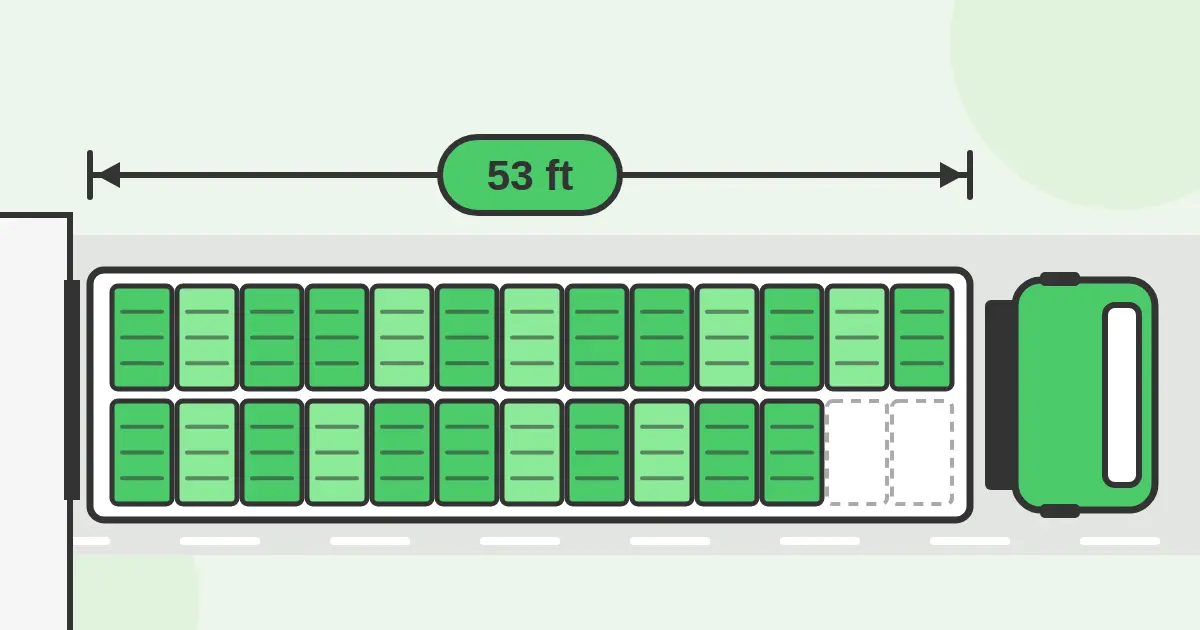
A 53-foot dry van fits 26 standard 48 × 40 inch pallets loaded straight, two across and 13 deep. Turn the pallets so the 48-inch side runs across the trailer and you fit 30. Double-stack them and the trailer holds 52 or 60, but only if the freight is light and short enough. In practice, heavy freight hits the 80,000 lb federal weight limit long before the floor is full.
The table below covers the 53-foot van, the 48-foot van, 20 and 40 foot containers, the 26-foot box truck and euro pallets. Every count comes from published inside dimensions, and we show the arithmetic so you can check it against your own equipment.
How many pallets fit in each trailer and container?
Single layer, no stacking. The 48 × 40 column is the standard U.S. pallet (often called a GMA pallet); the euro column is 1200 × 800 mm.
| Equipment | Inside floor (length × width) | 48 × 40 in pallets | Euro pallets (1200 × 800 mm) |
|---|---|---|---|
| 53 ft dry van | 52 ft 6 in × 98.5–101 in | 26 straight, 28 pinwheeled, 30 turned | 39 |
| 48 ft dry van | About 47 ft 6 in × 98.5–101 in (assumed; varies by trailer) | 22 straight, 24 with one turned row, 28 turned | About 36 |
| 40 ft and 40 ft high cube container | 39 ft 5 in × 7 ft 8.5 in (12,032 × 2,350 mm) | 20 (mixed orientation) | 25 |
| 20 ft container | 19 ft 4 in × 7 ft 8.5 in (5,896 × 2,350 mm) | 9 | 11 |
| 26 ft box truck | 25 ft 11 in × 8 ft 1 in | 12 straight, 14 turned (1 in to spare) | 19 |
| European 13.6 m semi-trailer | 13.62 × 2.48 m | Not the usual load | 33 |
The counts are our own floor-plan math from typical inside dimensions. Trailers vary by an inch or two between makes, so check your carrier's equipment if you are planning to the last pallet.
Why does a 53-foot trailer hold 26 pallets?
Because 13 rows of 48-inch-deep pallets fill the length, with two pallets side by side in each row, 40-inch sides facing the doors.
A 53-foot trailer is 53 feet on the outside. Inside, after the front wall and the rear doors, a typical dry van has about 52 ft 6 in (630 inches) of usable length, 98.5 to 101 inches of width depending on the wall type, and about 110 inches of height.
Load a 48 × 40 pallet "straight", with the 40-inch side facing the doors, and two of them take 80 inches of width. Each row is 48 inches deep, so 630 ÷ 48 = 13.1, which rounds down to 13 rows. Two pallets times 13 rows is 26. That leaves 6 inches at the back: the trailer is full even though you can still see floor.
Straight, turned or pinwheeled: which pattern fits more pallets?
Turned loading fits the most, 30 pallets, but only if the trailer is at least 96 inches wide inside. Pinwheeling is the fallback when it isn't.
| Pattern | How the pallets sit | Width used | Rows in 630 in | Pallets |
|---|---|---|---|---|
| Straight | 40 in side across the trailer, both pallets | 80 in | 13 + 13 | 26 |
| Pinwheeled | One column straight, one column turned | 88 in | 13 + 15 | 28 |
| Turned | 48 in side across the trailer, both pallets | 96 in | 15 + 15 | 30 |
Turned loading leaves 2.5 inches of play in a 98.5-inch van and 5 inches in a 101-inch one. That is enough on paper. In a trailer with dented scuff liners, logistics posts or pallets that overhang their deck by an inch, it is not, and the forklift driver will find out at row nine. Pinwheeling needs only 88 inches, so it works in almost any van, and it still gets you two more pallets than straight loading.
Straight loading is the default for a reason: it is the fastest to load and unload, and any pallet jack can get under the pallets from the door side. If you are not short of space, load straight.
Can you double-stack pallets in a 53-foot trailer?
Yes, if the freight is light, the bottom pallets can carry the top ones, and each stacked unit is short enough. Double-stacking doubles the floor count to 52 pallets straight or 60 turned.
Height is the first check. With roughly 110 inches inside, two pallets stacked need to come in under about 53 to 54 inches each, including the wooden deck, so the forklift has a couple of inches to lift the top one clear. Tall pallets of 60 inches or more cannot stack at all.
The second check is the bottom pallet. Cartons of bottled drinks or canned food carry weight well. Cartons of chips, bedding or anything that crushes do not, which is why shippers mark these loads "do not stack". The third check is weight.
When does weight limit the pallet count before space does?
With a 45,000 lb payload, as soon as your pallets average more than about 1,730 lb each. Federal rules cap a truck at 80,000 lb gross, with no more than 20,000 lb on a single axle and 34,000 lb on a tandem axle group.[1] The tractor and the empty trailer count toward that 80,000 lb.
Here is the arithmetic for an example rig where the tractor and empty trailer weigh 35,000 lb, leaving a 45,000 lb payload. Your carrier knows the real figure for its own equipment, and it can be several thousand pounds either way.
| Load | Pallets | Average weight per pallet at 45,000 lb payload |
|---|---|---|
| 53 ft, straight | 26 | About 1,730 lb |
| 53 ft, turned | 30 | 1,500 lb |
| 53 ft, double-stacked straight | 52 | About 865 lb |
| 53 ft, double-stacked turned | 60 | 750 lb |
A full trailer of paper, beverages or tiles weighs out (hits the weight limit) with floor space left over. A trailer of insulation or empty plastic bottles cubes out (runs out of space) with most of the weight allowance unused. Both count as a full truckload to the carrier, which is why the pallet count on a booking tells you more about the unloading work than the word "FTL" does.
Spread heavy pallets along the trailer rather than bunching them at the front or rear. The total can be legal while the tandem at the back is over 34,000 lb, and that is what the weigh station catches.
How many pallets fit in a 48-foot trailer?
About 22 standard pallets loaded straight, 24 with one turned row at the back, and 28 turned. Inside length varies more between 48-foot trailers than between 53-foot ones, so treat these as typical rather than exact.
Assuming about 570 inches of inside length, 11 straight rows (22 pallets) take 528 inches. The remaining 42 inches fit one turned row of two pallets, for 24. Turned all the way, 570 ÷ 40 = 14 rows, or 28 pallets.
The 48-foot van is still common in regional and dedicated fleets. If a lane uses 48-foot equipment, expect two to four pallets fewer than a 53 loaded straight and give it a slightly shorter dock slot.
How many pallets fit in a 20 ft or 40 ft container?
A 20 ft container fits 9 standard 48 × 40 pallets and a 40 ft container fits 20. Euro pallets fit better: 11 and 25. A 40 ft high cube has the same floor as a standard 40 ft, only about a foot more height, so the single-layer count is the same.
The limit is width. A standard dry container is about 2,350 mm (92.5 in) wide inside. Two 48 × 40 pallets turned need 96 inches, so turned loading is impossible. Two pallets loaded straight take 80 inches, and the best floor plan mixes a column of straight pallets with a column of turned ones (88 inches), the same pinwheel pattern as in a trailer. In a 40 ft that gives 11 + 9 = 20.
You will see 10 pallets quoted for a 20 ft container and 21 for a 40 ft. We could not make 48 × 40 pallets fit those counts using standard inside dimensions. The higher numbers usually come from smaller pallets, or from counts that ignore the container's real inside width. Ask the forwarder which pallet size their number assumes before you plan around it.
Containers arriving at your dock are often floor-loaded, not palletized at all, because ocean freight is paid by the box and loose cartons fill it better. That changes the unloading time far more than the pallet count does.
How many pallets fit in a 26-foot box truck?
Twelve standard pallets loaded straight. A typical 26-foot rental box truck is about 25 ft 11 in long and 8 ft 1 in wide inside, with up to 10,000 lb of payload.
Six straight rows of 48 inches use 288 of the 311 inches. Turned, the pallets need 96 of the 97 inches of width, which fits 14 on paper but leaves one inch of clearance. And with 10,000 lb of payload spread across 12 pallets, each pallet can average only about 830 lb. Box trucks weigh out quickly.
How do euro pallets compare with U.S. pallets?
A euro pallet is 1200 × 800 mm (about 47.2 × 31.5 in), smaller than the 48 × 40 in U.S. pallet. Three euro pallets side by side take 94.5 inches, so they fit across a U.S. 53-foot van, and 13 rows fit along it, for 39 euro pallets.
In Europe the standard semi-trailer is 13.6 meters inside and holds 33 euro pallets: three across, 11 deep. If you receive European imports, a "full load" of 33 euro pallets is roughly the same floor area as 26 U.S. pallets in a 53-foot van.
The 48 × 40 in pallet is the most common size in the U.S., but far from the only one. Check what your suppliers actually ship before you plan on the standard count.
What does pallet count mean for your dock schedule?
It tells you roughly how long the truck will sit at your door, which is the number your dock schedule runs on.
How the freight is packed matters as much as how many pallets there are. In a 1998 Supervalu study reported by Supermarket News, a palletized trailer of boxed meat took 62 minutes to unload, and the same product floor-loaded took 142 minutes.[2] The U.S. Department of Transportation's Inspector General found an informal industry consensus that two hours is a reasonable estimate for loading or unloading a truck.[3] Two hours is also where free time usually ends and detention starts.
So a booking for a 26-pallet trailer and a booking for a floor-loaded 40 ft container are different jobs, even though both are "one truck". The container may need a crew or a lumper (see what lumper fees are and who pays them), and it ties up the door for more than twice as long. Whether it should be a live load or a drop trailer depends on the same number.
The practical step is to stop giving every truck the same slot. Set up a few load types (full palletized trailer, part load, floor-loaded container) with their own duration, and let carriers pick the type when they book. LoadingCalendar does this with time slots sized by load type, for $99 a month flat with a 14-day trial.
Pallet count feeds two other plans. Turn it into unloading time, multiply by trucks per day, and you can work out how many dock doors you need. Compare it with the packing list at the door and you have the first check in your warehouse receiving process.
Frequently asked questions
Sources
- 23 CFR § 658.17, Weight: maximum gross vehicle weight 80,000 lb; 20,000 lb on a single axle; 34,000 lb on a tandem axle. law.cornell.edu
- Supermarket News, "Palletization cuts product turnaround times: study" (February 1998): Supervalu, CHEP and Excel Corp. study, 62 minutes to unload palletized boxed meat against 142 minutes floor-loaded. supermarketnews.com
- U.S. Department of Transportation, Office of Inspector General, "Estimates Show Commercial Driver Detention Increases Crash Risks and Costs, but Current Data Limit Further Analysis", report ST2018019 (31 January 2018): informal industry consensus of 2 hours for loading or unloading. oig.dot.gov
Trailer and container dimensions are typical inside dimensions, and the pallet counts are our own floor-plan math. Real counts depend on pallet overhang, wall liners, load bars and the exact trailer. The 45,000 lb payload and the 570-inch inside length of a 48 ft van are assumptions for the examples, not standards.
You might also like
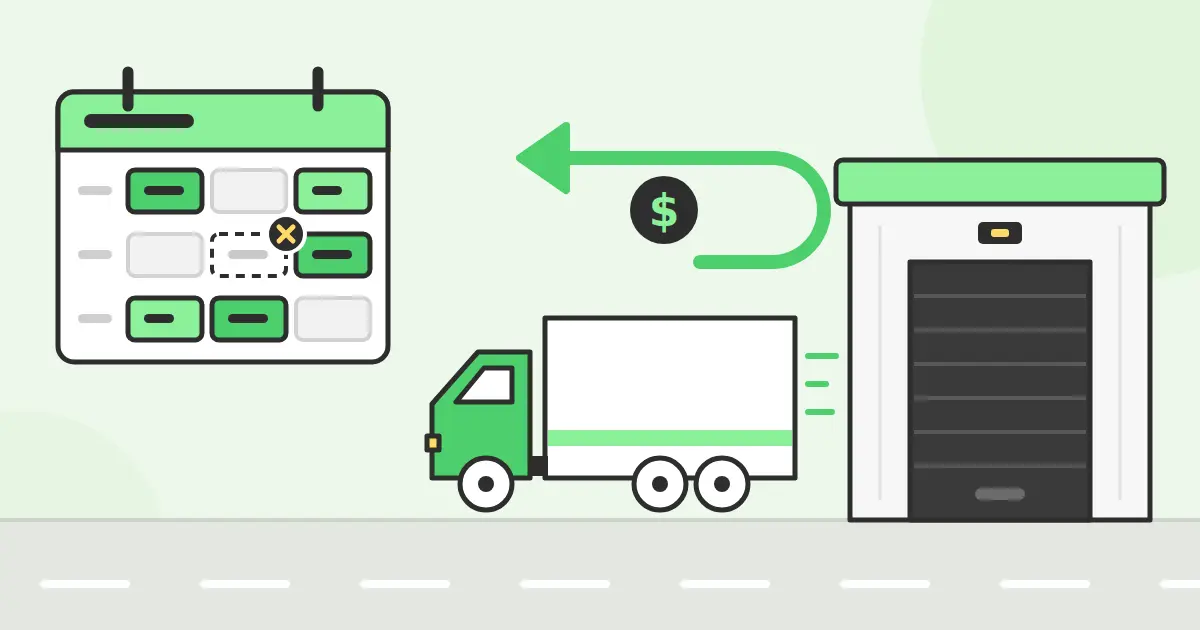
TONU means truck ordered, not used: a fee for cancelling a truck too late. What carriers charge, who pays and how shippers and warehouses avoid it.
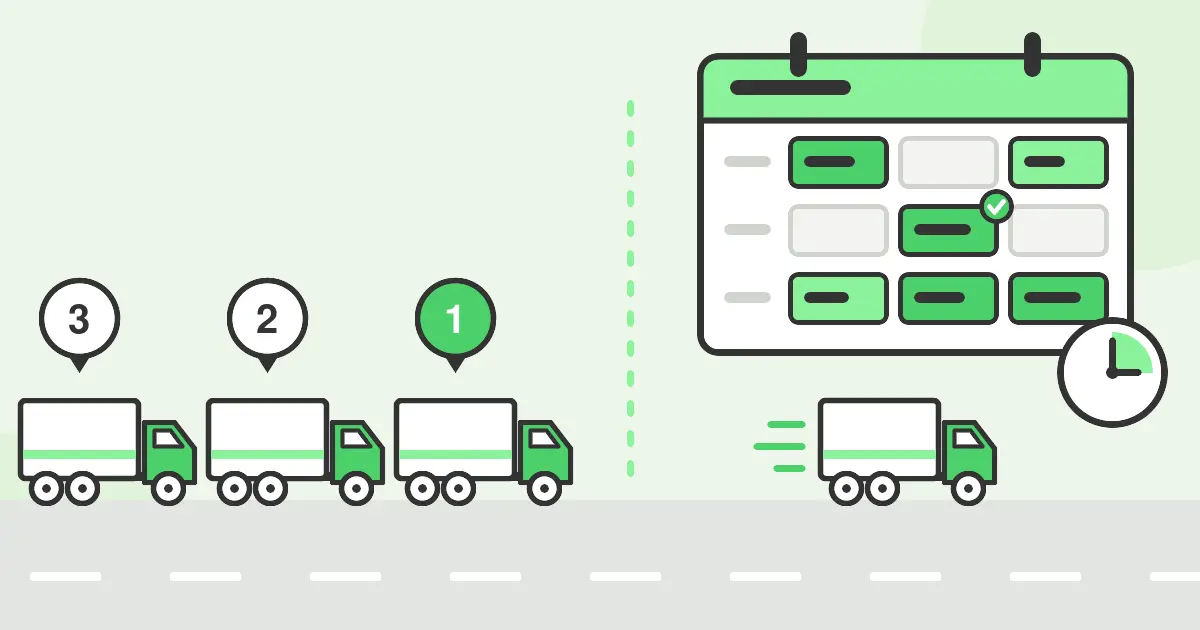
FCFS means first come, first served: trucks are worked in arrival order. How it differs from appointments, when detention starts and when to switch.

A loading dock safety checklist with the OSHA rule behind every line: wheel chocks, vehicle restraints, dock edges, dockboards, lighting and forklift training.
Ready for simpler warehouse scheduling?
Join warehouse teams across the world that replaced spreadsheets and phone calls with simple dock appointment scheduling software.
Start My Free Trial 14-day free trial · No credit card required · Cancel anytime