Live Load vs Drop Trailer in Trucking: Which Is Right for Your Dock?
A live load keeps the driver and truck at your door until the work is done. A drop trailer stays in your yard while the driver leaves. Here is what each costs and how to schedule both so neither turns into detention.

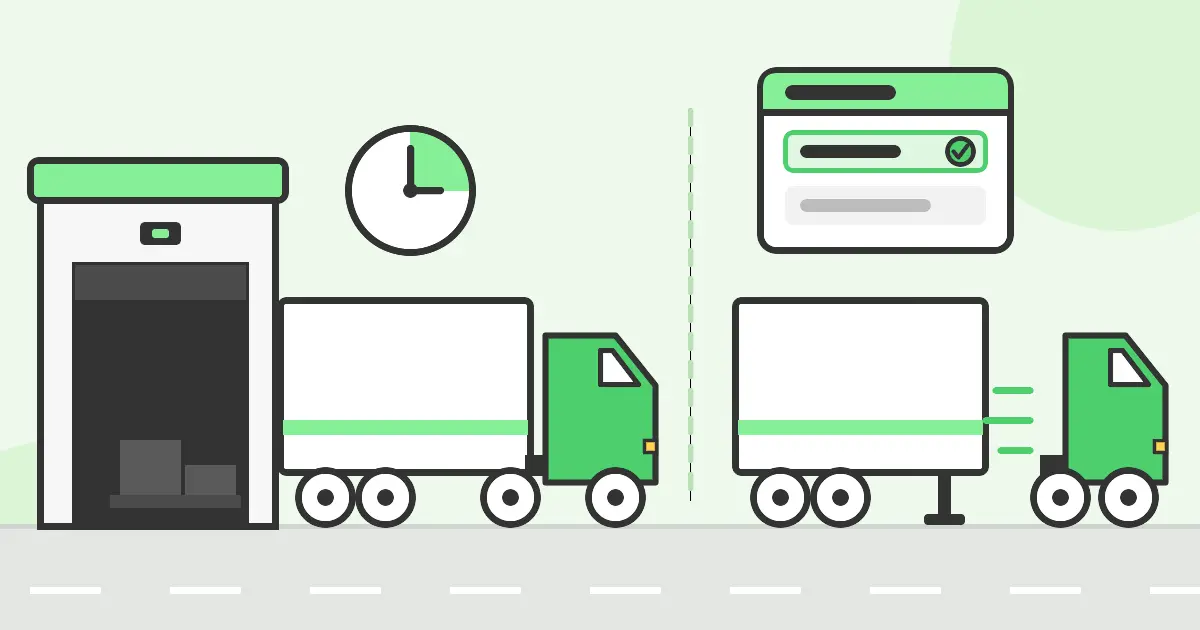
In trucking, a live load means the driver backs up to your dock door and waits with the truck while your team loads or unloads it. A drop trailer (often called drop and hook) means the carrier parks a trailer in your yard, the driver goes, and your team works on it when it suits you. Live loading needs less yard space and no spare trailers, but every minute your dock runs late is a minute the carrier can bill as detention. Drop trailers take the driver off your clock, but you pay for it in yard space, trailer fees and the work of keeping track of trailers.
You don't have to pick one. Many warehouses live load the irregular freight, drop the steady lanes, and schedule the two differently. Here's how to decide which goes where.
What is a live load in trucking?
A live load is a pickup where the driver stays with the truck at your dock door while your team loads the trailer, then drives away with it. The truck, the trailer and the driver arrive and leave together. There is one trailer per tractor, and nothing is left on your property.
A live unload is the same thing in the other direction: an inbound truck arrives, the driver waits while you unload, and the empty trailer leaves with the driver. Depending on the contract, the driver waits in the cab or helps with the freight, or a third-party crew unloads it and charges a lumper fee.
From the warehouse side, a live load ties up two things at once: one of your dock doors and the carrier's driver. That second part is why most detention happens on live loads.
What is a drop trailer, and what does drop and hook mean?
A drop trailer is a trailer the carrier leaves at your facility to be loaded or unloaded later. The driver unhooks it in your yard or at a door and leaves with the tractor, often after hooking up a trailer you have already loaded or emptied. That swap is the "drop and hook".
The two terms get used interchangeably, but they describe different things. The drop trailer is the equipment sitting on your property. Drop and hook is the visit: drop one trailer, hook another, leave. If a driver only drops a trailer and comes back for it tomorrow, that is still a drop trailer arrangement.
Carriers like drop and hook because the driver doesn't wait. Trucking Dive reported in 2024 that about 80% of Werner's one-way truckload business runs as drop and hook, from a pool of 30,000 trailers, and DAT's chief scientist Chris Caplice put it simply: "If they can use drop and hook, they will use drop and hook."[4]
Live load vs drop trailer: what is the difference?
The difference is who waits. In a live load, the driver waits for your dock. In a drop trailer arrangement, the trailer waits and the driver doesn't. Everything else in the table follows from that.
| Factor | Live load / live unload | Drop trailer (drop and hook) |
|---|---|---|
| Who waits | Driver and truck, at your door | Trailer only, in your yard or at a door |
| Trailers on site | None after the truck leaves | One or more per lane, all the time |
| Yard space needed | Only for trucks queueing to dock | Parking slots for every dropped trailer |
| Dock door time | Booked for the full load time at a fixed hour | Used whenever your team gets to it |
| Detention risk | High: every hour past free time is billable | Low, unless the trailer isn't ready at pickup |
| Typical extra charges | Detention, lumper fees | Per-day trailer fees after free time, yard handling |
| Who it suits | Irregular freight, small carriers, tight yards | Steady daily volume on the same lanes |
How long does a live load take?
Plan on about two hours. When the U.S. Department of Transportation's Inspector General interviewed industry stakeholders, 11 of 12 said there is an informal consensus that 2 hours is a reasonable estimate for loading or unloading, and the average dwell time in the 2013 federal data it analyzed was 113 minutes.[2]
Your number will differ by freight. The same report notes that cargo type and packaging change the time needed. A trailer of shrink-wrapped pallets you can pull with a pallet jack might clear in 30 to 45 minutes. A floor-loaded container of loose cartons can take a crew three hours or more.
The useful number is your own. Time a week of live loads from the moment the truck docks to the moment it pulls away, split by freight type. You'll use it to size appointment slots.
Does a live load cause detention?
A live load causes detention when the truck stays longer than the free time in the contract, which is usually two hours. ATRI uses the same line: its 2024 study treats any dwell over two hours as detention, and found drivers were detained at 39.3% of stops in 2023.[1]
Freight type changes the odds a lot. ATRI measured detention at 56.2% of refrigerated stops, 32.6% of dry van truckload stops, 26.2% of flatbed and 19.3% of specialized. The same report says drop-and-hook shipments "are less susceptible to detention", while live loads "require drivers to wait (or assist)".[1]
Detention costs the carrier more than the wait. Drivers get 14 consecutive hours after coming on duty before they must stop driving,[3] and a four-hour unload uses up more than a quarter of that window. ATRI found that 52% of truckload drivers had run out of on-duty hours at a customer facility because of detention at least once in 2023.[1] Carriers can price that in: a dock known for long live loads risks higher rates or fewer carriers willing to take the lane.
The bill itself is easy to estimate. ATRI's median detention rate for truckload carriers was $50 an hour in 2023, the lowest of any sector. A live unload that takes three and a half hours against two hours of free time costs $75. If that happens ten times a week, it is about $39,000 a year. Our guide to how truck detention works covers the billing rules and who pays.
Do drop trailers cost more?
Often, yes, just in different places. Drop trailers don't remove cost: they move it from the driver's time to trailers and yard space. Before you agree to a drop program, check these lines:
- Trailer fees. Carriers often allow a set number of free days for a trailer on your property and charge a daily fee after that. The free days and the fee are negotiated per contract, so read your rate confirmations.
- Yard space. Every dropped trailer needs a parking slot that doesn't block your doors or the truck route. If your yard holds six trailers and you already have five, the next drop turns into a live unload.
- Moving trailers. Somebody has to pull the trailer from the yard to a door and back. Larger sites use a yard truck and a driver. Smaller ones ask the carrier's driver to move it to a door, which brings the waiting problem back.
- Keeping track. You need to know which trailer is where, whether it is loaded, empty or in progress, and which carrier owns it. A lost trailer becomes a missed pickup.
- Carrier equipment. A drop program only works if the carrier has spare trailers. ATRI notes that building trailer pools "requires additional investment in equipment",[1] so a fleet with one trailer per truck has nothing to leave with you.
Whether the freight rate itself is lower for drop and hook depends on the lane and the carrier. There is no neutral, current benchmark for it, so ask for both prices when you get quotes for a lane.
When is drop and hook better than a live load?
Drop and hook is better when you ship or receive steady volume on the same lanes, have yard space for spare trailers, and your dock team can't promise to finish within free time. Live loading is better when freight is irregular, your yard is small, or your carriers are small fleets without trailer pools.
| Your situation | Lean toward | Why |
|---|---|---|
| You fill at least one trailer a day on the same lane | Drop | A trailer waiting at a door gets loaded in the quiet hours |
| Volume is irregular or below a trailer a day | Live | A dropped trailer would sit half-empty and collect daily fees |
| Your yard has little or no trailer parking | Live | There is nowhere to drop without blocking the docks |
| Doors are busy all day, every day | Drop | Work moves to off-peak hours instead of queueing trucks |
| You work one shift, but trucks arrive outside it | Drop | Drivers can drop after hours and your team unloads in the morning |
| Refrigerated freight | Depends | Detention is most common here, but a reefer trailer needs power or fuel while it waits |
| Mostly small carriers and owner-operators | Live | With one trailer per truck, they have nothing to leave with you |
| Detention invoices keep coming | Drop for the worst lanes | Start with the lanes that run past free time most often |
If busy doors are your main problem, check how many dock doors you need before you change how freight moves. Sometimes the fix is spreading appointments across the day, not dropping trailers.
What does your dock need to run drop trailers?
Four things: trailers ready before pickup, marked yard slots, someone directing drivers, and a record of what is on site. ATRI lists three reasons a drop and hook still ends up delayed: the trailer "has not been loaded prior to scheduled arrival", there is "no available space at the facility" to leave it, or there is nobody "to direct the driver to the correct location of the trailer".[1] Each one is a warehouse problem, so a drop program needs:
- Loaded trailers finished and sealed before the carrier's pickup time, not around it.
- Marked yard slots, with a rule for what happens when they are full.
- A clear owner at the gate who tells drivers where to drop and which trailer to hook.
- A record of every trailer on site, its status and its carrier.
If you have dozens of trailers in the yard at any time, you need a yard management system to keep that record. For most mid-size sites, a schedule plus a whiteboard by the gate is enough. Our comparison of dock scheduling vs yard management explains where the line is.
How do you schedule live loads and drop trailers?
Schedule them as two different kinds of appointment. A live load is a door appointment: a fixed time on a specific door, as long as the work takes. A drop or hook is a short arrival: the driver needs a few minutes at the gate and a yard slot, not a door at that hour. The door work on a dropped trailer gets scheduled separately, by you, for when the team has time.
- Size live slots by freight. Use the times you measured. If palletized loads take an hour and floor-loaded ones take three, make those two separate load types instead of one average slot that is wrong for both.
- Give drops a short slot. A 15- or 30-minute arrival window is enough to check the driver in and point them to a yard spot. Limit drop appointments to the doors or areas where trailers can actually be left.
- Book door time for dropped trailers. Reserve the door for your own team to work the trailer, ideally in quieter hours. Carriers should not be able to book that time.
- Book the hook when the trailer is ready. Let the carrier book the pickup only for a time after the trailer will be finished. That one rule removes the first reason ATRI gives for delayed drops.
In LoadingCalendar, you set up each kind of slot as a load type with its own duration (from 15 minutes up to 24 hours) and limit it to the doors where it belongs. Carriers pick the load type when they book through the carrier booking portal, so the slot length matches the job, and recurring or one-off reservations block door time for your own team. See time slot management for how slots are set up.
It costs $99 a month flat, with a 14-day trial and no card required. If live unloads are already running into detention, our steps on how to reduce detention fees are the next read.
Frequently asked questions
Sources
- American Transportation Research Institute (ATRI), "Costs and Consequences of Truck Driver Detention: A Comprehensive Analysis" (September 2024): two-hour detention definition; detention at 39.3% of stops in 2023; detention by sector (refrigerated 56.2%, dry van truckload 32.6%, flatbed 26.2%, specialized 19.3%); drop-and-hook less susceptible to detention and causes of drop delays; trailer pool investment; 52% of truckload drivers out of on-duty hours at a facility; median truckload detention fee of $50/hour. truckingresearch.org
- U.S. Department of Transportation, Office of Inspector General, "Estimates Show Commercial Driver Detention Increases Crash Risks and Costs, but Current Data Limit Further Analysis", report ST2018019 (31 January 2018): informal industry consensus of 2 hours for loading or unloading; typical 2-hour contract free time; average dwell time of 113 minutes in 2013 data. oig.dot.gov
- Electronic Code of Federal Regulations, 49 CFR 395.3, "Maximum driving time for property-carrying vehicles": the 14-hour on-duty window. ecfr.gov
- Shefali Kapadia, "Why carriers, shippers use drop and hook in good times and bad", Trucking Dive (16 February 2024): Werner's 30,000-trailer pool and 80% drop-and-hook share of one-way truckload; quote from Chris Caplice, DAT. truckingdive.com
The detention cost example (three and a half hours on site, $50/hour, ten times a week) and the loading times by freight type are illustrative, not measured data. Free time, detention rates and trailer fees vary by carrier and contract.
You might also like

A lumper fee pays third-party workers to unload a truck at the receiver's dock. What it costs, who pays by law and in practice, and how to keep it fair.
Italy, Spain, Portugal and Hungary set truck waiting time compensation in law. France sets a default; the rest of Europe leaves it to contracts.
Work out how many loading dock doors you need: the dock planning formula, a free calculator, peak-hour sizing and a queueing table for buffer doors.
Ready for simpler warehouse scheduling?
Join warehouse teams across the world that replaced spreadsheets and phone calls with simple dock appointment scheduling software.
Start My Free Trial 14-day free trial · No credit card required · Cancel anytime