North Carolina Organics Recycling LLC is a pre-consumer food and beverage recycling business. Off-spec organic material, everything from soda and soup to beer, arrives shrink-wrapped on pallets in its original packaging, with truckloads arriving every day. Through a line of specialised equipment, it de-palletises, de-cases and de-packages the material across six loading docks, then bales and sells the clean packaging, including cardboard, plastics (PET and HDPE), steel, aluminium and glass. The organic contents are routed to their highest and best use.
That last part is at the heart of the business. Depending on the material, the organic waste may be transported to an anaerobic digestion plant to produce renewable natural gas, used as animal feed, sent to a rendering company for pet food production, or converted into OMRI-listed compost for local farmers. Nothing that can be recovered ends up in landfill.
It is a deliberately lean operation with around twenty employees and six docks, focusing strongly on efficiency. Founder Fred Mussari spent fifteen years working in the municipal and industrial water and wastewater treatment industry before deciding to embark on one final adventure. He built the business around the principle of finding the best possible use for each material and doing so efficiently enough to compete with landfill sites on cost.
Before LoadingCalendar: enterprise software for a problem that wasn't enterprise-sized
The company had been using OpenDock, a capable dock scheduling platform. But Fred found that it was built for a very different type of operation.
It was also more expensive than the company actually needed, and each year, Fred found himself questioning its cost-effectiveness.
Before the introduction of a scheduling tool, tracking loads was a manual and error-prone process. When a driver arrived, the team simply worked with whatever paperwork the driver brought.
This required constant follow-up: sending emails and making phone calls to match a truckload to a load, find a missing BOL number or resolve an issue with a purchase order.
How they found LoadingCalendar: an AI recommendation
The search for a replacement began in a very modern way. Fred asked Grok for suggestions, narrowed down the options, and chose LoadingCalendar.
The timing was good: as the company was building a new website, the scheduling tool was integrated into it. Customers could now book their own deliveries, and the team could schedule pick-ups for outgoing goods from the same place.
Getting started just took a couple of phone calls
For a company that had just left a complex platform behind, the onboarding process was almost effortless. There was no lengthy implementation project or drawn-out configuration process.
The setup is easy to match. Scheduling and customer communication are handled from the front office across two desktop screens and a laptop, while receiving and inventory work is carried out on one of the desktops. When trucks arrive, another team member collects the hard copy paperwork from the driver, matches it to the information in LoadingCalendar and the load moves through the day's schedule and into the depackaging process.
One place for every number
Customers now enter their own BOL, release or PO numbers into LoadingCalendar when they schedule, which means every truckload can be matched to a booking before it even arrives.
All the information that the back office needs, such as purchase order numbers, customer numbers, seal numbers and truck numbers, is stored in one centralized place and is ready when the team invoices on a weekly basis.
For an operation that values simplicity, the appeal is that the tool does what's needed and nothing more.
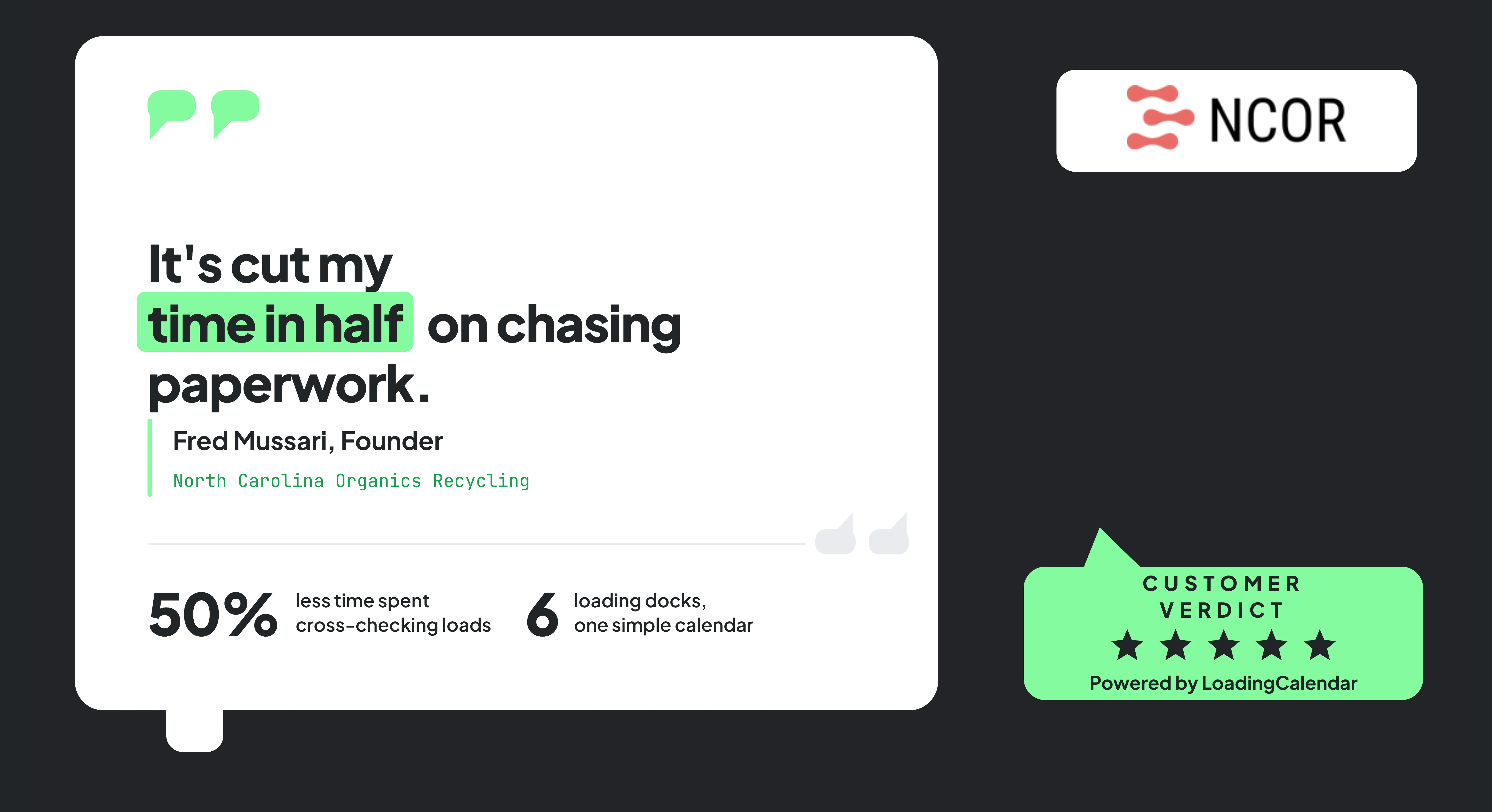
The result: cross-checking time cut in half
There is no longer any need for after-the-fact chasing. Because the correct numbers are provided at the time of booking, the cycle of emails and calls to sort out paperwork has mostly come to an end.
Fred admits that this is an estimate rather than an exact figure, as the company doesn't formally track the time spent reconciling loads. However, the effect on the day is obvious. The previous work was pure overhead: cross-checking that added no value to anyone.
He also points to a softer benefit he describes as voluntary compliance. Because the scheduling process is straightforward and accessible via the company's website, customers are willing to provide the necessary information without being prompted.
That ease shows up in how the market perceives the business. In an industry largely driven by national brokers placing material on behalf of major food and beverage brands, being easy to work with is a competitive advantage.
LoadingCalendar: The right fit for small and mid-sized docks
Fred's recommendation is shaped by the exact fit problem that led him to switch in the first place. LoadingCalendar suits small-to-medium operations that receive and ship a moderate volume and want to keep things simple.
For his own business, which receives two to three hundred tons a day across ten to fifteen tractor-trailers, that fit is what delivers the return.
This philosophy of continuous process improvement, one simple tool at a time, is the basis of how he runs the whole company.
You might also like
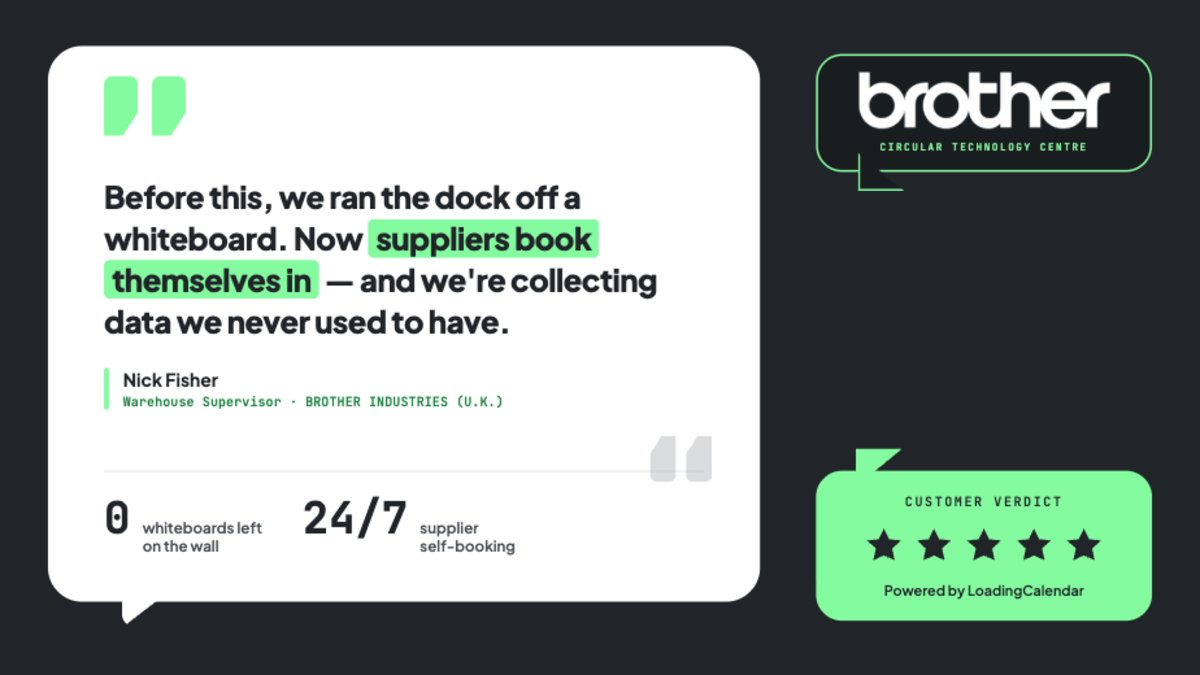
How the warehouse team at Brother's Circular Technology Centre in Wrexham replaced whiteboard dock planning with LoadingCalendar — suppliers book their own slots and the site collects loading data it never used to have.
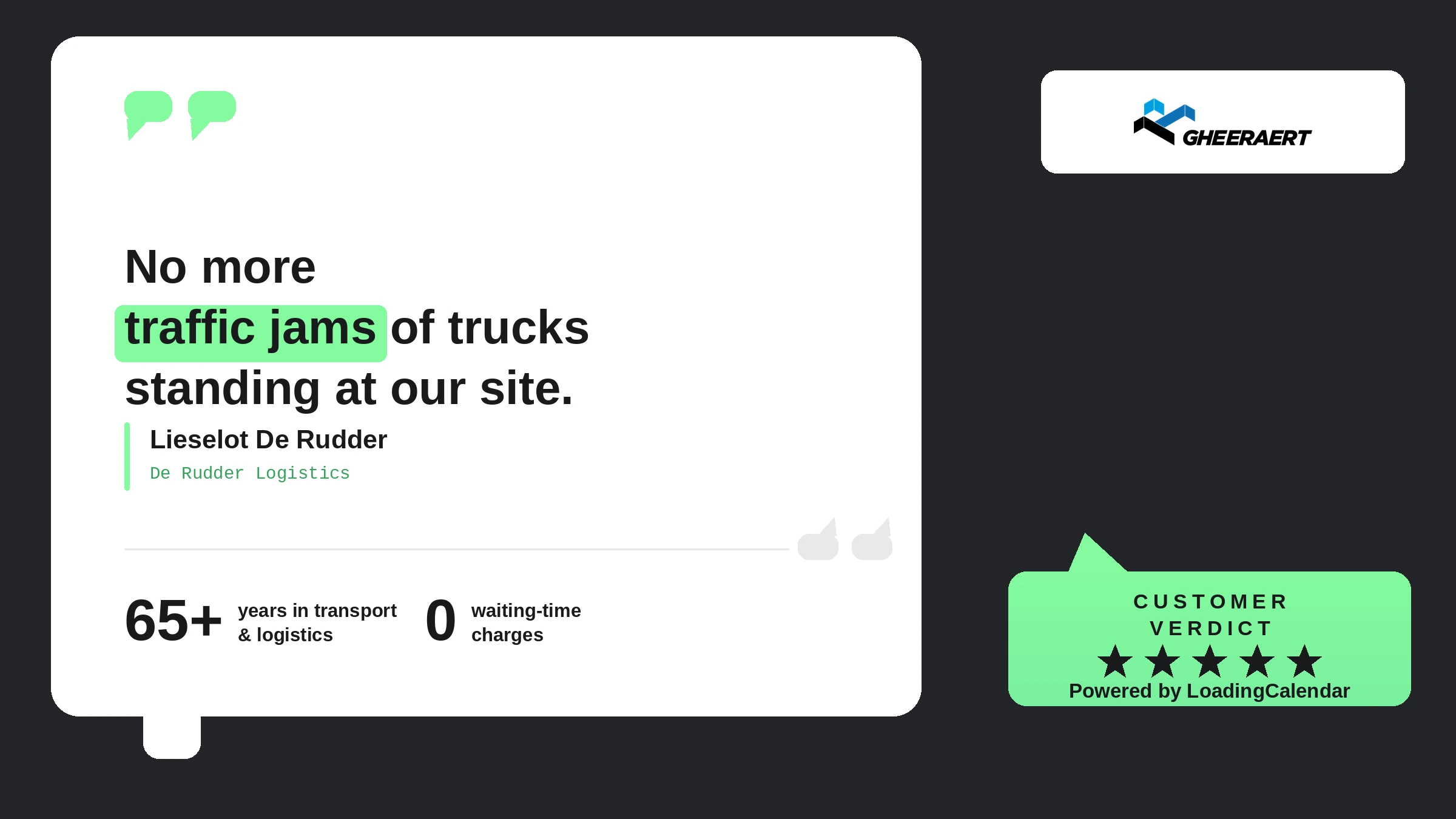
How Gheeraert, a 65-year-old West Flanders transport and logistics group, replaced an unreliable Excel schedule with LoadingCalendar — ending truck queues at its docks and cutting waiting-time charges.
How POLIPAKS, a Baltic packaging manufacturer shipping to 30+ markets, replaced paper loading plans and scattered Excel and Outlook calendars with one live LoadingCalendar dock schedule.
Ready for simpler warehouse scheduling?
Join warehouse teams across the world that replaced spreadsheets and phone calls with simple dock appointment scheduling software.
Start My Free Trial 14-day free trial · No credit card required · Cancel anytime