What Is TONU (Truck Ordered Not Used)? Fees, Who Pays and How Shippers Avoid It
Most TONU explainers are written for carriers trying to collect. This one is for the shipper or warehouse that gets the bill: what published carrier tariffs charge, how much notice you have to give, and how to stop paying for trucks you never loaded.

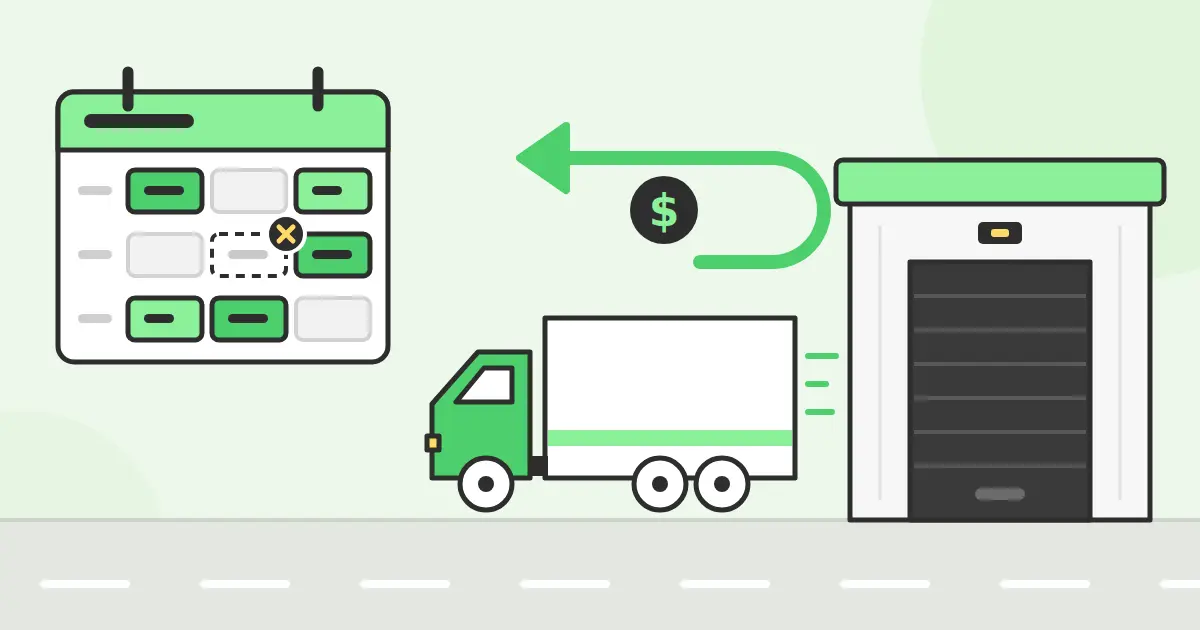
TONU stands for truck ordered, not used (also written "truck order not used"). It is a fee a carrier charges when you book a truck and then cancel too late, or when the truck shows up and the freight is not ready to load. Published carrier tariffs put it at $350 to $400 for a standard truckload and $600 for a refrigerated one, usually when you cancel less than 24 hours before pickup.[2][3][5]
TONU is a contract charge, not a regulated one. The amount and the notice period are whatever the carrier's rules tariff (its published terms), your contract or the rate confirmation for the load says, which makes it negotiable before the load and hard to argue after it. Below: what triggers a TONU, what carriers publish, who ends up paying, how it differs from detention, layover and deadhead, and how a shipping or receiving team avoids it.
What does TONU mean in trucking?
TONU means the carrier reserved a truck and a driver for your load and never got to haul it. DAT describes it as a fee carriers charge when a truck is ordered but not used, to compensate for the earnings lost during that time.[1] The truck may have driven empty to your site, or it may only have been held back from other freight.
On an invoice it is an accessorial charge, meaning a line billed separately from the linehaul rate (the price of the haul itself). With a TONU there is no linehaul at all: the fee is the whole invoice. Some carriers list it under longer names, such as "vehicle requested but not used" (Schneider) or "equipment ordered not used" (J.B. Hunt).
When can a carrier charge a TONU fee?
A carrier can charge a TONU when its tariff or your contract provides for it and one of three things happens. Published tariffs describe the triggers in similar terms:
- Late cancellation. You cancel inside the notice window. Twenty-four hours before the scheduled pickup is the most common cut-off in the terms we checked; some use 8 or 6 hours.[2][3][4]
- Truck arrives but cannot be loaded. The truck arrives and cannot be loaded through no fault of the carrier: the order is not picked, the product is on quality hold or the dock turns the driver away.
- Freight never tendered. A pickup was requested and nothing was handed over. CFI's tariff covers both of the last two cases in one sentence: equipment "furnished but not used, through no fault of Carrier", or a shipper that "fails to tender a shipment for transportation".[3]
Some terms add a condition that works in your favor. ArcBest's booking terms charge the fee only once a driver has been dispatched and the cancellation falls within 24 hours of the scheduled pickup time.[6] Union Pacific, which pays truckers as a customer, writes the same logic into its supplier terms. It accepts a TONU when the driver arrives on site and is told the load is not ready or cancelled, and refuses one when the shipper gave 24 hours' notice of the cancellation.[7]
How much is a TONU fee?
A truckload TONU is a flat $350 to $400 per truck in the tariffs we checked, and $600 for temperature-controlled freight. J.B. Hunt's quick rate terms bill per mile instead, with a $250 minimum. The table shows what four carriers' public terms said when we checked them in November 2026.
| Carrier | Service | TONU charge | Charged when |
|---|---|---|---|
| Schneider[2] | Truckload | $350 | Order cancelled within 24 hours of the requested pickup time |
| Schneider[2] | Intermodal | $350 | Order cancelled within 6 hours of the requested pickup time |
| CFI[3] | Dry van truckload | $350 | Order cancelled within 24 hours of the scheduled pickup time, unless a comparable load is offered |
| CFI[3] | Temperature-controlled truckload | $600 | Same as dry van |
| J.B. Hunt (quick rate terms)[4] | All services (general terms) | $2.50 per mile from the truck's last destination to the pickup, minimum $250 | Load cancelled less than 8 hours before the scheduled pickup |
| XGS[5] | Truckload or volume shipment | $400 | Pickup attempted, then cancelled without freight being tendered |
Your contract overrides these numbers. A tariff is the carrier's default. A negotiated agreement or the rate confirmation for a specific load can set a different amount, a different cut-off or no TONU at all.
Lower figures are still widely quoted. Anderson Trucking Service (ATS) wrote in 2023 that most TONU fees run $150 to $300 per truck, and at least $500 for a specialized load.[8] A 2014 Transplace benchmark covering more than 150 shippers found that 64% applied a TONU charge in their freight terms, most often $250 (43% of them) or $150 (39%).[9] The truckload tariffs in the table sit above both, so for a full truckload budget closer to $350. Drayage schedules go lower: Union Pacific's supplier schedule lists $100 for a cancelled load.[7]
Can other charges be added on top of a TONU?
Yes. CFI's tariff says detention charges apply to equipment that was ordered but not used. It also says that when the customer has asked the carrier to deadhead a truck to the loading point and the load is cancelled after dispatch, the deadhead charge ($1.75 per mile for dry van and $2.00 for temperature-controlled, plus fuel surcharge) applies in addition to the TONU.[3]
Take those published rates. You ask the carrier to bring a refrigerated truck 80 empty miles to your dock, then cancel after it has been dispatched. The TONU is $600 and the deadhead is 80 × $2.00 = $160. That is $760 before fuel surcharge, for a truck that hauled nothing.
Who pays the TONU fee: the shipper, the broker or the receiver?
The party responsible for the freight charges pays. ATS defines TONU as a fee levied "on the party responsible for paying the freight charges",[8] which in practice is whoever booked the truck.
For a warehouse, that plays out in three ways:
- You booked the carrier directly. The carrier bills you. This is the usual case for outbound freight you pay for.
- You booked through a broker. The carrier bills the broker, because the broker is its customer. The broker then passes the charge on to you if your agreement with the broker allows it.
- Your supplier or customer booked the truck. They get the invoice. If the cancellation was your doing (your dock turned the truck away, or the order was not staged for a customer pickup), expect them to ask you for the money. This is where a receiver usually stands on inbound freight.
When a broker passes a TONU on, you can ask to see the broker's record of the transaction. Federal rules require brokers to keep one, showing the freight charges the broker collected and its own compensation, and give each party to a brokered transaction the right to review it.[11] The same goes for who pays a lumper fee: paperwork written before the truck was booked settles it, so read the accessorial lines before you tender the load.
What is the difference between TONU, detention, layover and deadhead?
TONU is charged when the load never moves. Detention and layover are charged when it moves late, and deadhead is charged for the empty miles driven to reach you. All four pay the carrier for time or distance that earned no linehaul.
| Charge | What triggers it | How it is billed | Published example |
|---|---|---|---|
| TONU | Truck booked, then the load is cancelled late or is not ready | Flat fee per truck, sometimes per mile | $350 per truckload (Schneider)[2] |
| Detention | Truck waits at the dock beyond the free time | Per hour or per 15 minutes | 2 hours free, then $60 per hour, maximum $500 (J.B. Hunt)[4] |
| Layover | Driver has to stay overnight to load or unload at a later date | Per day | $750 per day for a single driver (Schneider)[2] |
| Deadhead | Truck drives empty to the loading point at the customer's request | Per mile | $1.75 per mile plus fuel surcharge, dry van (CFI)[3] |
The practical difference for a warehouse is timing. Detention grows by the hour while a truck sits at your dock, so you can still limit it. A TONU is fixed the moment you cancel inside the window. For the hourly side, see how truck detention is calculated and billed.
Is TONU regulated by law or set by contract?
TONU is set by contract. We found no federal rule that fixes a TONU amount or a notice period. Federal law lets a carrier contract with a shipper to provide "specified services under specified rates and conditions",[10] and TONU is one of those conditions. It lives in the carrier's rules tariff, your transportation contract or the rate confirmation for the load.
On every rate confirmation or carrier agreement, look for the TONU amount, the cut-off (how many hours before pickup you can cancel for free) and whether deadhead or detention can be added. If the pickup is a first-come, first-served window and not a fixed appointment, also ask which time the cut-off counts back from. Our guide to FCFS windows vs appointment scheduling explains why the two behave differently.
This section describes US law in general terms. It is not legal advice for a specific dispute.
Why do loads get cancelled at the last minute?
Most last-minute cancellations start inside the shipper's own building, hours before anyone tells the carrier. In our experience the usual causes are:
- The order is not ready. Production ran late, the pick is not finished or the product is on quality hold, and nobody told the person who booked the truck.
- The order changed. The customer cut the quantity or pushed the delivery date, so the truck on its way is the wrong size or coming on the wrong day.
- The truck was booked twice. Two planners, or a planner and a broker, each ordered a truck for the same load.
- The dock cannot take it. The door is occupied, the shift is short-staffed, or the appointment was moved and the carrier never heard about it.
In most of these cases somebody in the building knew before the cut-off. The fee is charged because that knowledge reached the carrier too late.
How do shippers and warehouses avoid TONU charges?
You avoid TONU by cancelling or rescheduling before the carrier's cut-off, and by knowing early enough that a load is in trouble. Six habits cover most of it:
- Know each carrier's cut-off. It is 24 hours in most of the published terms we checked and 6 or 8 hours in some. Put the number where the people who book trucks can see it.
- Confirm the freight is ready before the cut-off. A daily check of tomorrow's pickups against production and picking status is enough. If a load is in doubt 24 hours out, that is the moment to decide, not the morning of the pickup.
- Reschedule before you cancel. CFI's tariff waives the TONU when the customer offers a comparable load.[3] Ask the carrier whether a new pickup time or another load settles it before you cancel outright.
- Cancel in writing, with a time on it. A phone call leaves no proof that you were outside the window. An email or a cancelled booking with a timestamp does.
- Give exact load details when you book. A dry van sent for a load that needs a refrigerated trailer is a truck you cannot use, and the fee is the same as for a cancellation.
- Keep the carrier and the dock on one schedule. If the dock moves an appointment, the carrier has to see the change. A truck that arrives for a slot that no longer exists ends in a TONU or a detention bill.
A shared dock calendar makes two of these habits routine: the readiness check, and keeping the carrier and the dock on one schedule. When pickups are booked as appointments, tomorrow's trucks are one list you can check against what is ready. In LoadingCalendar, carriers book through a carrier booking portal and can cancel their own bookings there. Status changes are logged with the time and the person who made them, which is the record you want when a TONU is disputed. LoadingCalendar costs $99 a month flat, with a 14-day trial and no card required.
Two related guides. How to track no-show rate and set a cancellation cut-off covers the same rule from the warehouse side. How to reduce detention fees at your warehouse matters here too, because unready loads cause both charges.
How do you check whether a TONU invoice is valid?
Start with three facts: a pickup was requested, a truck came to make it and no freight was picked up. That is the check the freight audit firm Universal Traffic Service says it applies to every TONU, after finding that a significant number of the TONU invoices it reviewed were not valid.[12] Under late-cancellation terms the truck need not have arrived, and there the cut-off is what counts.
Then check the terms. Was the cancellation inside the cut-off? Is the amount the one in the tariff or the rate confirmation? If deadhead miles are billed, from where? Your own timestamps (when the pickup was booked, when it was cancelled, whether a driver checked in at the gate) settle most of these questions in one email.
Frequently asked questions
Sources
- DAT Freight & Analytics, "Understanding Freight Accessorial Charges" (22 March 2024): definition of the TONU fee. dat.com
- Schneider National Carriers / Schneider Transport, "Tariff No. 101: Rules/Accessorials Tariff" (effective 1 October 2026): $350 when a truckload order is cancelled within 24 hours of the requested pickup time, or an intermodal order within 6 hours; layover $750 per day for a single driver. schneider.com (document)
- Contract Freighters, Inc. (CFI), "Rules Tariff" (28 November 2022), items 705.07 and 705.14: TONU of $350 for dry van and $600 for temperature-controlled loads cancelled within 24 hours of the scheduled pickup without offer of a comparable load; detention applies to equipment ordered but not used; customer-requested deadhead of $1.75 (dry van) or $2.00 (temperature-controlled) per mile applies in addition to TONU when a load is cancelled after dispatch. Read 13 November 2026. cfidrive.com (document)
- J.B. Hunt, "Quick Rate Terms and Conditions" (read 13 November 2026): no charge for loads cancelled eight hours before scheduled pickup; otherwise $2.50 per mile with a $250 minimum; detention of $60 per hour after two hours of free time, maximum $500. jbhunt.com
- Xpress Global Systems (XGS), "Tariff 3500: Rules Tariff", item 730 (effective 19 May 2025): TONU fee of $400 for a truckload or volume shipment pickup that is attempted but cancelled without tender of the freight. xgsi.com
- ArcBest, "Booking Request Terms and Conditions" (read 13 November 2026): truck ordered but not used fee once a driver is dispatched and the shipment is cancelled within 24 hours of the scheduled pickup time. arcb.com
- Union Pacific Railroad, supplier "Accessorial Charges and Payment Terms" (undated; PDF created December 2023; read 13 November 2026): TONU when the driver arrives on site and is advised that the load is not ready or cancelled; not approved if 24 hours' notice was given; $100 for a cancelled load. up.com
- Anderson Trucking Service (ATS), "What is a Truck Order Not Used (TONU) Fee?" (published 27 July 2022, updated 28 March 2023): most TONU fees $150 to $300 per truck; specialized loads no less than $500; the fee is levied on the party responsible for paying the freight charges. atsinc.com
- FleetOwner / Refrigerated Transporter, "Study identifies trends in shipper freight charges" (12 February 2014), reporting Transplace's accessorial benchmarking study of more than 150 shippers: 64% of shippers apply a TONU charge; of those, 43% use $250 and 39% use $150. fleetowner.com
- United States Code, 49 U.S.C. § 14101(b)(1): a carrier may enter into a contract with a shipper to provide specified services under specified rates and conditions. law.cornell.edu
- Code of Federal Regulations, 49 CFR § 371.3: records to be kept by brokers, and the right of each party to a brokered transaction to review the record. law.cornell.edu
- Universal Traffic Service, "Spike in Invoices for Truck Ordered Not Used" (undated; read 13 November 2026): the three-point check applied to every TONU invoice. myuts.net
Tariff figures are the carriers' published default terms as we read them in November 2026. Negotiated contracts override them, and carriers revise tariffs without notice. The 80-mile refrigerated example is illustrative arithmetic using CFI's published rates.
You might also like
FCFS means first come, first served: trucks are worked in arrival order. How it differs from appointments, when detention starts and when to switch.
A loading dock safety checklist with the OSHA rule behind every line: wheel chocks, vehicle restraints, dock edges, dockboards, lighting and forklift training.
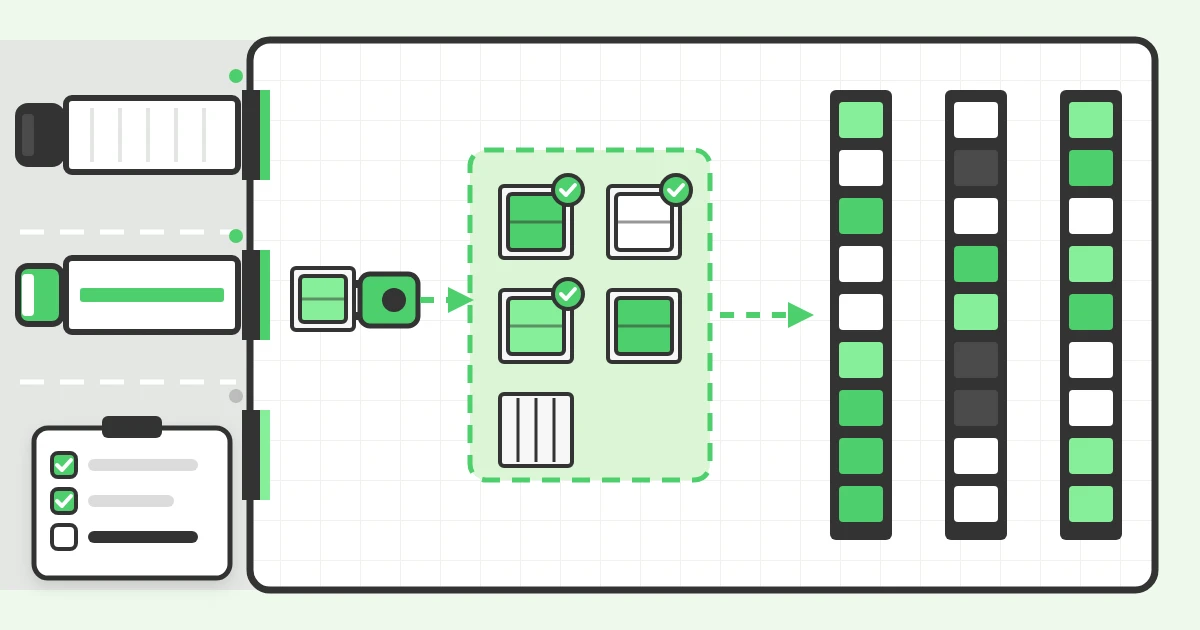
The warehouse receiving process step by step, from booking the truck to putaway. Where receiving breaks, what we recommend and a receiving checklist.
Ready for simpler warehouse scheduling?
Join warehouse teams across the world that replaced spreadsheets and phone calls with simple dock appointment scheduling software.
Start My Free Trial 14-day free trial · No credit card required · Cancel anytime