How to Reduce Truck Detention Fees at Your Warehouse
Most detention is created inside the facility, not on the road. Here's how to get the invoices down to zero: a fair free-time window, an appointment system carriers actually use, and timestamps that hold up in a dispute.

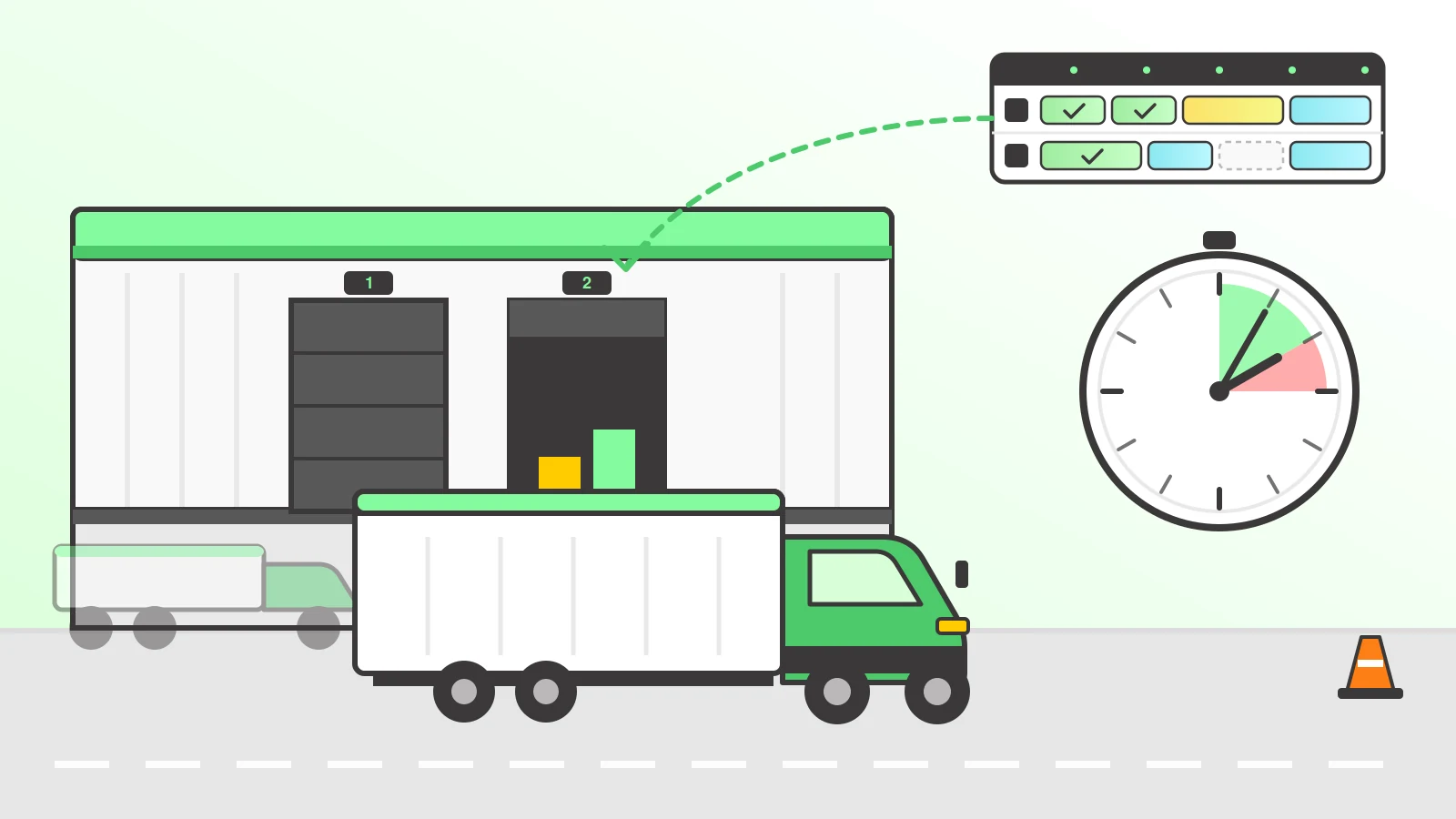
To reduce detention fees, a warehouse needs to do three things: spread truck arrivals across the day with appointments, prepare each dock before the truck lands, and log arrival, dock-in and departure times automatically. Detention is billed at roughly $50–$100 per hour after a two-hour free window, and ATRI's 2024 study found drivers were detained at 39.3% of stops. Almost all of that waiting is caused by the facility, which means the facility can fix it.
This guide is for the receiving or shipping site that pays the invoices. If you first want the definitions, who bills whom, and how truck detention differs from port demurrage, read what is truck detention. Here we skip the theory and go straight to what cuts the number, with or without warehouse scheduling software.
Why do detention fees happen?
Detention fees happen when a truck waits at a facility longer than the free time in the carrier contract, and the main reason trucks wait is that arrivals are not spread out. Drivers show up in clumps, the docks are busy or unprepared, and the free-time clock runs while the truck sits in the yard.
ATRI's 2024 detention study put the industry-wide cost at $15.1 billion for 2023 (about 135 million hours lost), and found detention concentrated at specific facilities rather than spread evenly across the network. That is the useful part: the problem sits with the sites, so the fix sits with the sites too.
The recurring causes we see at warehouses that come to us with a detention problem:
| Cause | What it looks like on the ground | Who controls it |
|---|---|---|
| No appointment system | Four trucks at 08:00, none at 14:00. Morning drivers queue; afternoon docks idle. | Warehouse |
| Double-booked docks | Two trucks assigned the same door and slot. One waits by definition. | Warehouse |
| Product or paperwork not ready | Pick isn't finished, BOL isn't printed, QA hasn't released the load. | Warehouse |
| Staffing doesn't match arrivals | Receiving crew is spread evenly across the shift; trucks aren't. | Warehouse |
| Nobody knows the truck has arrived | Driver parks, walks to the office, waits at a window. Fifteen minutes gone. | Warehouse |
| Equipment or lumper delays | Waiting for a forklift, a crew, an open door. | Warehouse |
| Carrier arrives outside its window | Truck shows up two hours early or late and expects service. | Carrier |
Six of the seven are inside the fence. Whether the seventh costs you anything depends on what your contract says about early and late arrivals, which is where free time comes in.
One more cost hides behind the invoice. Carriers keep records of which facilities detain them. A site that regularly holds trucks for three or four hours gets quoted higher rates, or gets declined during tight capacity. That surcharge never appears as a line item.
What's a fair free-time window?
Two hours of free time per stop is the standard in most carrier contracts and rate confirmations, and a warehouse that keeps average dwell under about 90 minutes will rarely trigger detention at all. Some contracts negotiate one hour (common for drop-and-hook or LTL) and some allow up to three or four hours for complex live loads, but two hours is the number to plan around.
What matters more than the length is what the contract says about when the clock starts. There are three candidate moments, and carriers, brokers and shippers reference different ones:
- Arrival time. The truck enters the yard or gate.
- Check-in time. The driver signs in and gets a dock assignment. Most shippers treat this as the official start.
- Scheduled appointment time. Free time runs from the booked slot, not from when the truck actually showed up.
The third option is the one a warehouse should push for. If free time starts at the appointment, a driver who arrives 90 minutes early isn't burning your free window in the yard, and a driver who arrives 90 minutes late is on their own clock. ATRI's data shows that early and late arrivals are a real share of "detention"; this clause moves them off your invoice.
A fair free-time clause for a mid-size warehouse:
| Term | Fair setting | Why |
|---|---|---|
| Free time, live load/unload | 2 hours | Industry standard; enough for a full-truckload live unload with a prepared dock |
| Free time, drop-and-hook | 30–60 minutes | The driver isn't waiting for handling |
| Clock starts | At the scheduled appointment (or check-in, if earlier arrival was requested by you) | Removes early-arrival disputes |
| Detention rate | $50–$100/hour, billed in 15- or 30-minute increments | Typical 2025–2026 range; specialized equipment up to about $125 |
| Notification | Carrier notifies before free time expires | Gives your team a chance to act while the truck is still there |
| Evidence | Facility timestamps take precedence over driver logs | Both sides know which record decides |
In Europe the mechanics are the same but the numbers come from the contract or the carrier's general terms: waiting-time compensation is usually agreed per started hour after a free period that is often shorter than two hours. Check your CMR-based agreements rather than assuming the US default.
The free-time window sets the ceiling on what you can be charged. Everything below is about staying well under it.
How does appointment scheduling cut detention?
Appointment scheduling cuts detention by turning a random flood of arrivals into a plannable curve, so each truck reaches a dock that is free, staffed and prepared. When trucks arrive at booked times, the two-hour free window is usually enough to finish the job, and the clock never reaches billable territory.
It works through four mechanisms:
1. Arrivals get spread across the day. With no appointment system, dispatchers send trucks when it suits the route, and the result is bunching: several trucks at opening time, an empty stretch after lunch. A dock calendar with fixed slot intervals (15, 30 or 60 minutes) caps how many trucks can arrive in the same window, so the peak flattens and each dock sees one truck at a time.
2. Slot length matches real loading time. A full-truckload live unload isn't a 30-minute job. When the schedule allows 30 minutes for a 90-minute task, every slot after it slips and the day ends with three trucks in the yard. Predefined loading durations (for example 60 minutes for a partial load, 120 minutes for FTL) keep the schedule honest.
3. Lead time gives you time to prepare. A minimum booking notice of a few hours, or a day, means receiving knows what's coming before the shift starts. Picks are finished, paperwork is printed, the door is assigned. The driver backs in and work begins, instead of the driver backing in and someone going to look for the order.
4. Labor follows the schedule. Once the day's arrivals are visible the night before, you can staff the 07:00–10:00 peak and thin out the afternoon, instead of spreading the crew evenly and hoping.
Here is what that does to a typical week. The numbers are illustrative, built from the ATRI averages and typical rates above, not measured at any one site:
| Phone-and-spreadsheet scheduling | Appointment scheduling | |
|---|---|---|
| Trucks per week | 60 | 60 |
| Share of trucks detained (ATRI avg: 39.3%) | ~24 trucks | 2–3 trucks |
| Average detention per detained truck | 1.5 hours | 0.5 hours |
| Detention at $75/hour | ~$2,700/week | ~$110/week |
| Annualized | ~$140,000 | ~$5,700 |
You can plug your own truck counts, dwell and rates into our warehouse scheduling software ROI calculator; it uses the same ATRI and rate sources, and shows its assumptions.
Two things decide whether an appointment system actually delivers this.
Carriers have to use it. If booking a slot means calling your office between 09:00 and 16:00, dispatchers will skip it and send the truck anyway. A self-service carrier booking portal where the carrier sees real availability and picks a slot without creating an account removes that friction. In our customers' experience, carriers adopt a portal quickly when the alternative is phone tag; Gheeraert's story is a good example of what happens to the queue when carriers book themselves.
Double-booking has to be impossible, not just discouraged. A shared spreadsheet lets two people book the same door for the same hour. Software that only shows slots which are actually free, per dock, per duration, closes that door. We wrote a separate guide on how to stop double-booking warehouse docks.
To be fair about the limits: appointment scheduling removes the causes a warehouse controls. It won't fix a carrier running four hours late, and it doesn't touch port-side demurrage. What it does is make the two-hour window sufficient nearly every time, which is where most detention disappears.
How do you document arrival times?
Document arrival times by logging three timestamps for every truck (arrival at the gate or yard, dock-in, and departure) in a system that records who entered them and when, rather than on a clipboard. Those three timestamps decide detention disputes, and ATRI's 2024 study found that fewer than half of the detention invoices carriers send actually get paid, mostly because the two sides can't agree on the times.
The dispute usually turns on the start time. The carrier's invoice says the driver arrived at 09:15; your gate log says 10:40; the driver's ELD shows the truck entering the geofence at 10:38. Whoever has the cleanest, most independent record wins. A handwritten sign-in sheet loses to an ELD. An appointment system with a status change logged at 10:41 by a named user holds up.
What to record, and where each timestamp comes from:
| Timestamp | Recorded when | Recorded by |
|---|---|---|
| Booked appointment | When the slot was reserved | Carrier (portal) or planner |
| Arrived | Driver checks in at the gate or office | Gate, receptionist or driver kiosk; status changes to arrived |
| Loading started | Truck is at the door and handling begins | Dock team; status changes to in progress |
| Loading completed / departed | Paperwork signed, truck released | Dock team; status changes to done, with signature |
| Any changes | Slot moved, plate changed, cancellation | Audit log, with user and origin |
With that record, checking a detention invoice takes two minutes: departure minus arrival (or minus appointment time, per the contract), subtract free time, multiply by the rate. If the carrier billed 3.5 hours and your log shows 58 minutes past free time at $75/hour, you dispute the difference with evidence rather than opinions.
Documentation does two more jobs beyond winning disputes:
- It shows you dwell time before the invoices do. Detention is a lagging indicator: by the time the bill arrives, the delay is weeks old. Average dwell per truck, by dock and by hour of day, tells you where the schedule and the staffing don't match while you can still change them.
- It keeps the relationship with carriers workable. A carrier that knows your timestamps are accurate stops padding invoices, and a carrier that gets paid promptly for genuine detention keeps sending you trucks.
Warehouse scheduling software captures these timestamps as a side effect of moving a loading through its statuses (new, arrived, in progress, done), so nobody has to remember to write anything down. The audit log records the user, the time and whether the change came from the warehouse, the carrier portal or an integrated TMS. If your loadings also flow through a TMS, a two-way sync can send the completion time and signature back automatically; see TMS and warehouse scheduling software integration.
Where should a warehouse start?
Start with the trucks you can see coming: put inbound deliveries on appointments first, set slot lengths that match reality, and start logging the three timestamps from day one. Most warehouses can have the first dock configured in under an hour and the first carriers booking within a week.
A practical order of work:
- Pull the last three months of detention invoices. Count them, total them, and note which carriers and which hours of the day they cluster around. This is your baseline and your first argument for the project.
- Fix the free-time clause. Confirm two hours per live stop, clock starting at the scheduled appointment, facility timestamps as evidence. Do it in the next contract renewal if you can't do it now.
- Define docks, hours and slot intervals. One calendar per warehouse, one row per dock, 30- or 60-minute intervals, realistic operating hours, and a lead time of at least a few hours.
- Set loading durations. Partial load, full load, container, pallet-only: give each a fixed length so the schedule stops lying to itself.
- Send carriers the booking link. Make self-booking the default and phone booking the exception. Put the portal link on your delivery instructions and purchase orders.
- Timestamp every truck from the first day. Arrived, in progress, done. Even before the schedule is perfect, the record is worth having.
- Review dwell weekly for the first month. Average dwell per dock and per hour shows where to move slots or staff.
If you're weighing tools, our comparison of the best warehouse scheduling software covers the options, including where competitors are stronger than we are. LoadingCalendar is $99/month flat for unlimited docks, users and carriers, with a 14-day trial and no credit card, which suits small and mid-size warehouses that want to set this up themselves. Larger 3PLs with complex yard operations may want something heavier.
Frequently asked questions
Sources
- American Transportation Research Institute (ATRI), 2024 truck driver detention study: $15.1 billion total cost for 2023, 39.3% of stops with detention, ~135 million hours lost, 94.5% of carriers charging detention with fewer than half of invoices paid. truckingresearch.org
- Typical detention rates ($50–$100/hour after a two-hour free window; specialized equipment up to about $125/hour): corroborated 2025–2026 freight industry rate reporting (Truckstop, Warp, FleetWorks).
- Worked example figures (60 trucks/week, $75/hour, 1.5 vs 0.5 hours detained) are illustrative calculations built from sources 1 and 2, not measured customer data.
You might also like
The four dock scheduling KPIs that matter: dock utilization rate, truck dwell time, on-time arrival rate and no-show rate. Formulas, a worked example and honest benchmarks.

OTIF (On Time In Full) is the share of orders delivered complete and within the agreed window. Formula, worked example, benchmarks and how to measure it.
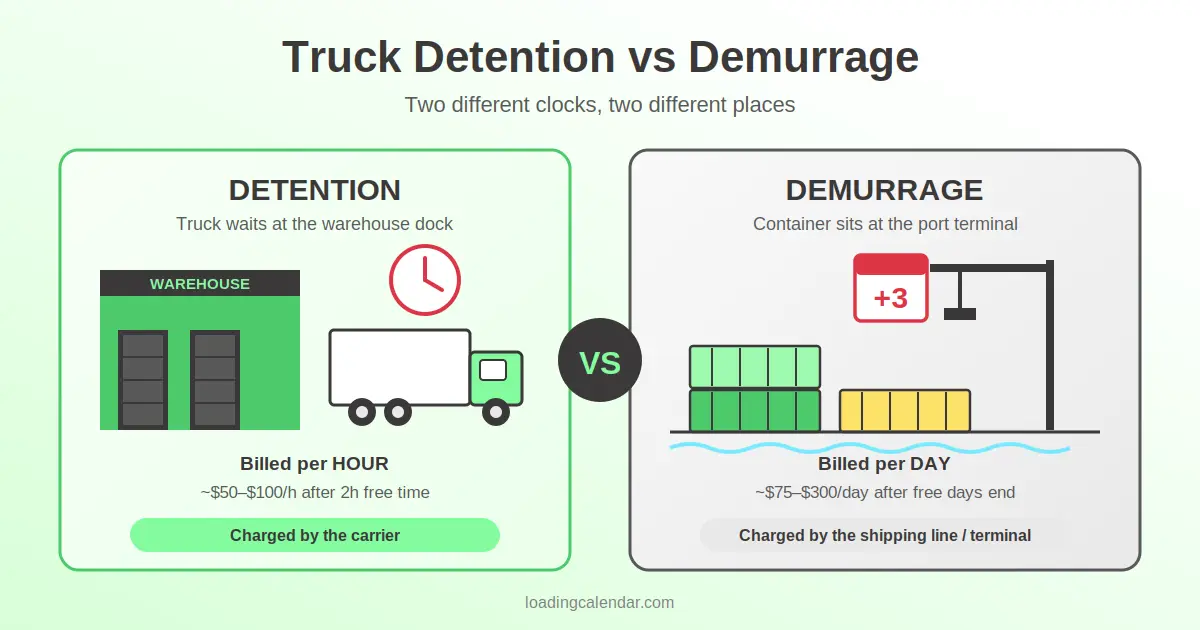
Truck detention is the fee carriers charge when drivers wait past free time — typically $50–$100/hour after 2 hours. Demurrage is a daily port charge. Here's the difference, who pays, and how to avoid both.
Ready for simpler warehouse scheduling?
Join warehouse teams across the world that replaced spreadsheets and phone calls with simple dock appointment scheduling software.
Start My Free Trial 14-day free trial · No credit card required · Cancel anytime