
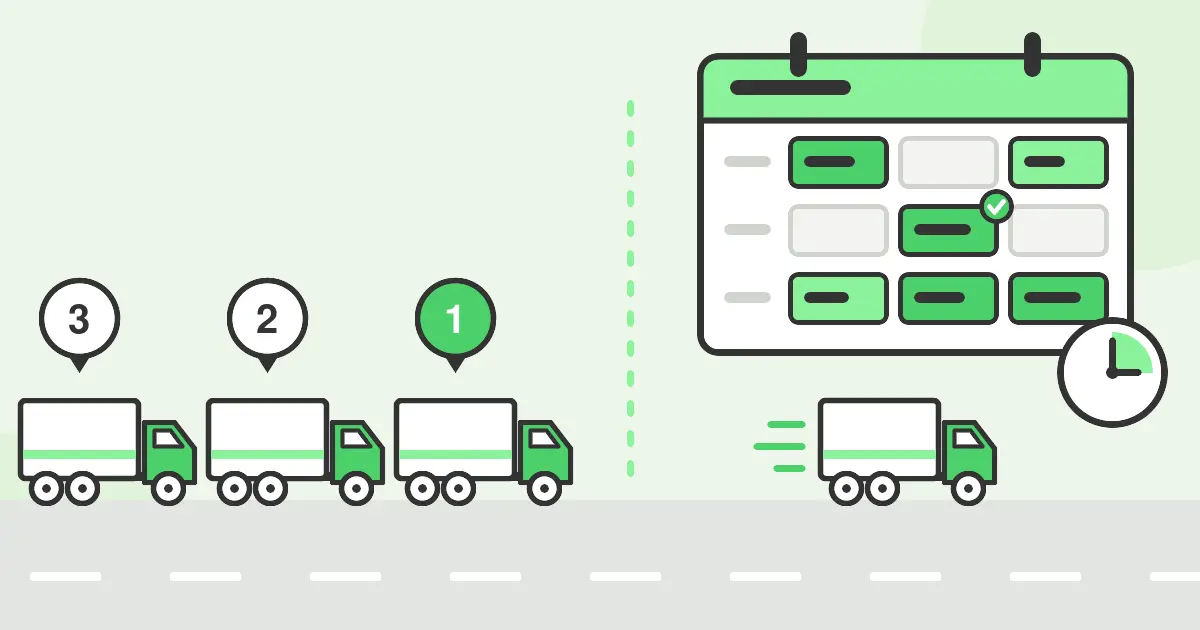
FCFS means first come, first served. In trucking, it describes a pickup or delivery where the warehouse works trucks in the order they arrive during set receiving hours, instead of giving each truck a booked time. The alternative is appointment scheduling, where every truck has a reserved slot at a dock.
Most explanations of FCFS are written for drivers. This one is written for the warehouse: what an FCFS window commits you to, when the detention clock starts, why FCFS docks back up, and how to tell when it is time to move to appointments.
What does FCFS mean in trucking?
FCFS (also written "first come, first serve") is a receiving policy with one rule: the truck that checks in first gets the next free door. There is no booking. The facility publishes its receiving hours, carriers send trucks inside those hours, and the dock team works through the line.
FCFS is popular because it needs no scheduler, no phone calls and no software, and drivers like the flexibility: a truck that is running two hours behind has not missed anything. For a warehouse with a few trucks a day and a spare door, it is the lowest-effort way to run a dock.
The cost shows up when volume grows. When the U.S. Government Accountability Office interviewed truck drivers about waiting at shipper and receiver facilities, about 34% of those who had been detained said facility scheduling practices led to it, and "first come, first serve" was one of the practices industry representatives named.[1] That report is from 2011. The mechanics have not changed.
What is an FCFS window on a rate confirmation?
An FCFS window is the date and hour range in which the driver may arrive, written on the rate confirmation (the load agreement between broker and carrier) as something like FCFS 08:00–15:00, often typed as 0800–1500. It gives the facility's receiving hours for that load, not a reserved slot.
For the carrier, arriving any time inside the window counts as on time. A truck that checks in at 08:05 and a truck that checks in at 14:40 have both met the requirement. A truck that arrives at 15:20 is late, and the warehouse can turn it away or work it the next day.
For the warehouse, the window is a promise in the other direction: any truck that arrives inside it expects to be worked that day. If the window says 08:00–15:00 and a load takes an hour, the truck that checks in at 14:55 is on time and somebody stays late. Close the window early enough to finish one more load before the dock team goes home.
What is the difference between FCFS and appointment scheduling?
Under FCFS the carrier decides when the truck arrives; under appointment scheduling the warehouse offers slots and the carrier books one. Everything else follows from that.
| FCFS | Appointment | |
|---|---|---|
| Who picks the arrival time | The carrier, anywhere inside the window | The warehouse offers slots, the carrier books one |
| What on time means | Checked in inside the window | Checked in at the booked time, within the grace period you set |
| Driver wait time | Unknown until arrival; depends on who else came | Short and predictable, if slots match door capacity |
| Labor planning | Staff for the worst hour or accept queues | Staff for the booked plan, hour by hour |
| Yard space | Room for a queue | Room for early arrivals only |
| Admin before arrival | None | Booking work, unless carriers book themselves |
| Detention clock starts | At check-in inside the window, if the contract says so | Usually at the appointment time, if the truck was on time |
| Fits best | Low volume, spare doors, flexible labor | Tight doors or labor, mixed load types |
Appointments are not automatically better. In the same GAO survey, 79.5% of drivers describing their most recent detention had an appointment for that load. About 43% of drivers blamed facility limitations (too few staff, too little equipment, too few bays), which GAO said can happen when facilities schedule more appointments than they can handle.[1] A calendar that books six trucks into four doors produces the same queue as FCFS, with more paperwork.
Does detention apply on FCFS loads?
Yes. Detention can apply on an FCFS load. What the contract has to settle is when free time (the unpaid waiting period before detention charges begin, usually two hours) starts, and on FCFS loads that is often left undefined.
Detention is normally measured against an appointment. The American Transportation Research Institute (ATRI) defines it as the additional time a driver must wait at a customer facility beyond the scheduled appointment time. Its 2024 study found that 67% of carriers that charge detention start billing at the two-hour mark.[2] An FCFS load has no appointment time to measure from. The only start point both sides can verify is the moment the truck checks in inside the window.
TQL, one of the largest U.S. freight brokers, treats the window the way it treats an appointment: it lists arriving on time for a scheduled appointment "or within the first come first serve window" among its requirements for detention pay, along with check-in and check-out times noted on the paperwork.[3] Lateness costs the carrier the claim: ATRI notes that a carrier may not be able to bill detention at all if the driver was late for the appointment.[2]
| Appointment load | FCFS load | |
|---|---|---|
| Free time starts | At the appointment time | At check-in inside the window, if the contract says so; often left undefined |
| Truck arrives early | Waiting before the appointment is not counted | Waiting before the window opens is not counted; inside the window, no arrival counts as early |
| Truck arrives late | The carrier usually loses the detention claim | Same, if it arrived after the window closed |
| Proof | Check-in and check-out times on the paperwork | The same, and it matters more: there is no booked time to fall back on |
Under FCFS, the warehouse does not control when the clock starts. The carrier does, by choosing when to check in. If ten trucks check in at 08:00, ten clocks start at 08:00. Write the start event into your carrier instructions (check-in at the gate, inside the window, with a timestamp both sides can see) and record it for every truck. Fees, free time and billing rules are covered in what truck detention is and how it is charged.
Why do FCFS docks back up?
FCFS docks back up because the policy rewards arriving first, so trucks bunch at opening time. GAO described drivers lining up at the gate before a facility opens to be served as quickly as possible, using seaport terminals as its example, and noted that the terminals did not treat that wait as detention.[1] ATRI's 2024 report lists arriving early, to be first in line, among the tactics drivers still use. It also points out the flaw: the driver spends that time waiting at the facility either way.[2]
Here is what that does to a four-door warehouse. The numbers are illustrative: 45 minutes per truck, a two-hour free-time clause that starts at check-in, and 16 trucks at the gate when it opens at 07:00.
| Trucks | Docks at | Leaves at | Waited for a door | Time on site | Past free time |
|---|---|---|---|---|---|
| 1–4 | 07:00 | 07:45 | 0 min | 45 min | None |
| 5–8 | 07:45 | 08:30 | 45 min | 1 h 30 min | None |
| 9–12 | 08:30 | 09:15 | 1 h 30 min | 2 h 15 min | 15 min each |
| 13–16 | 09:15 | 10:00 | 2 h 15 min | 3 h | 1 h each |
The dock did nothing wrong. Every door was busy from 07:00 to 10:00 and every truck took exactly 45 minutes. Eight trucks still went past free time, for five billable truck-hours. At $50 an hour, the median truckload detention fee in ATRI's 2024 study, that is $250 for one morning.[2]
Now give the same 16 trucks appointments, four every 45 minutes. The last truck still leaves at 10:00 and the dock does the same work in the same three hours. But each truck arrives when its door is free and is on site for about 45 minutes, so nothing passes free time. Scheduling added no capacity. It moved the waiting off your yard and off the detention invoice.
Is FCFS or appointment scheduling better for a warehouse?
Appointments are better once your busiest hour brings more trucks than your doors can turn. Below that point, FCFS is simpler and works fine.
The test is arithmetic. Count the trucks that arrive in your busiest hour and compare that with what your doors can finish in an hour. Four doors at 45 minutes per truck turn about five trucks an hour. If six or more regularly arrive in that hour, a queue forms, and it only clears once arrivals drop below five.
| Your situation | FCFS fits | Appointments fit |
|---|---|---|
| Trucks in the busiest hour | Fewer than your doors can turn | More than your doors can turn |
| Load types | One type, similar unload times | Mixed: pallets, floor-loaded, parcel, containers |
| Yard | Room for a queue off the street | Tight yard, trucks waiting on the road |
| Labor | The dock team has other work between trucks | Fixed shifts that need steady work all day |
| Carriers | Many one-off carriers, irregular lanes | Regular carriers on repeat lanes |
| Detention invoices | Rare | Most months |
| Live load or drop trailer | Mostly drop trailers (the trailer waits, the driver does not) | Mostly live loads (the driver waits) |
If the arithmetic says you are short of doors even with arrivals spread across the day, the question becomes how many dock doors you need. And if much of your freight could be dropped instead of worked live, compare live load vs drop trailer first, because a dropped trailer takes the driver's clock out of the picture.
When should a warehouse switch from FCFS to appointments?
Switch when the queue has become a cost you can point to. These are the signs, roughly in the order they appear:
- Trucks are parked at the gate before you open.
- The dock is overloaded until mid-morning and half idle after lunch.
- Detention invoices arrive most months, and you have no timestamps to dispute them with.
- The team works overtime to clear trucks that checked in just before the window closed.
- Nobody can tell a carrier, or your own customer service, when a given truck will be loaded.
No published threshold says FCFS stops working at a certain number of trucks per day, so treat any figure you see quoted as a guess. One of these signs is a nuisance. Three or more mean the queue is costing you money every week. The same pattern is behind the signs that a warehouse has outgrown whiteboard scheduling.
Can you combine FCFS and appointments?
Yes. A mix is often the easiest way out of pure FCFS, because it changes the rules only where the queue hurts. Three models are common:
- Appointments for the busy hours, FCFS for the rest. Book the hours that back up and leave the quiet hours open. Carriers who want certainty book a slot. Carriers who cannot commit to a time come in the afternoon.
- Standing appointments for regular carriers. A carrier that delivers every Tuesday and Thursday gets the same slot every week without booking it each time. Everyone else books around those slots.
- Work-ins. A truck that arrives without an appointment, or misses its slot, is worked in when a door is free, behind the trucks that are on time.
GAO described a facility running exactly that last rule: carriers are scheduled every 30 minutes with a goal of loading or unloading each one within 90 minutes. A carrier that misses its appointment is unloaded whenever possible but never bumps a carrier that arrived on time.[1]
Whatever mix you choose, publish it. A carrier should be able to read on one page which hours need a booking, which are open, and where a late truck stands.
How do you switch from FCFS to appointments without losing carriers?
Make booking less work for the carrier than waiting in line was. In practice that takes four steps:
- Measure for two weeks. Write down check-in and departure times for every truck. You need two numbers: trucks in the busiest hour, and real time at the door per load type.
- Set slots from those numbers. Give each load type its own slot length, and never offer more slots in an hour than you have doors. This is the step that prevents the overbooking GAO described.
- Let carriers book themselves. If booking means emailing your office and waiting for a reply, carriers will keep showing up unannounced.
- Keep a work-in rule. Tell carriers that an unbooked truck will still be worked, after the booked ones. Nobody is turned away, and booking becomes the faster option.
Step three decides whether the change sticks. With LoadingCalendar, carriers open your carrier booking portal, pick a slot and confirm, with no account to create. The calendar only shows slots that are still open. Regular deliveries can be set to repeat daily or weekly, which covers standing appointments. It costs $99 a month flat, with a 14-day trial and no card required.
Start with the hours that back up and the three or four carriers that send the most trucks. Our guide to setting up a warehouse appointment system covers the rollout, including what to do about carriers who keep calling out of habit.
Frequently asked questions
Sources
- U.S. Government Accountability Office, "Commercial Motor Carriers: More Could Be Done to Determine Impact of Excessive Loading and Unloading Wait Times on Hours of Service Violations", GAO-11-198 (January 2011): 34% of interviewed drivers who had experienced detention citing facility scheduling practices, with "first come, first serve" named; drivers lining up before opening; 43% citing facility limitations and overscheduled appointments; 79.5% of drivers having an appointment at their last detention; the 30-minute appointment example. gao.gov
- American Transportation Research Institute (ATRI), "Costs and Consequences of Truck Driver Detention: A Comprehensive Analysis" (September 2024): definition of detention against the scheduled appointment time; 67% of carriers that charge detention starting at two hours; median truckload detention fee of $50 per hour (2023); late arrival and detention billing; early arrival as a driver tactic. truckingresearch.org
- Total Quality Logistics (TQL), Carrier FAQs, "What are the requirements for receiving detention/layover pay?" (accessed November 2026). tql.com
The four-door warehouse example is illustrative arithmetic, not measured data. Free time, detention rates and the event that starts the clock vary by contract.
You might also like
A loading dock safety checklist with the OSHA rule behind every line: wheel chocks, vehicle restraints, dock edges, dockboards, lighting and forklift training.
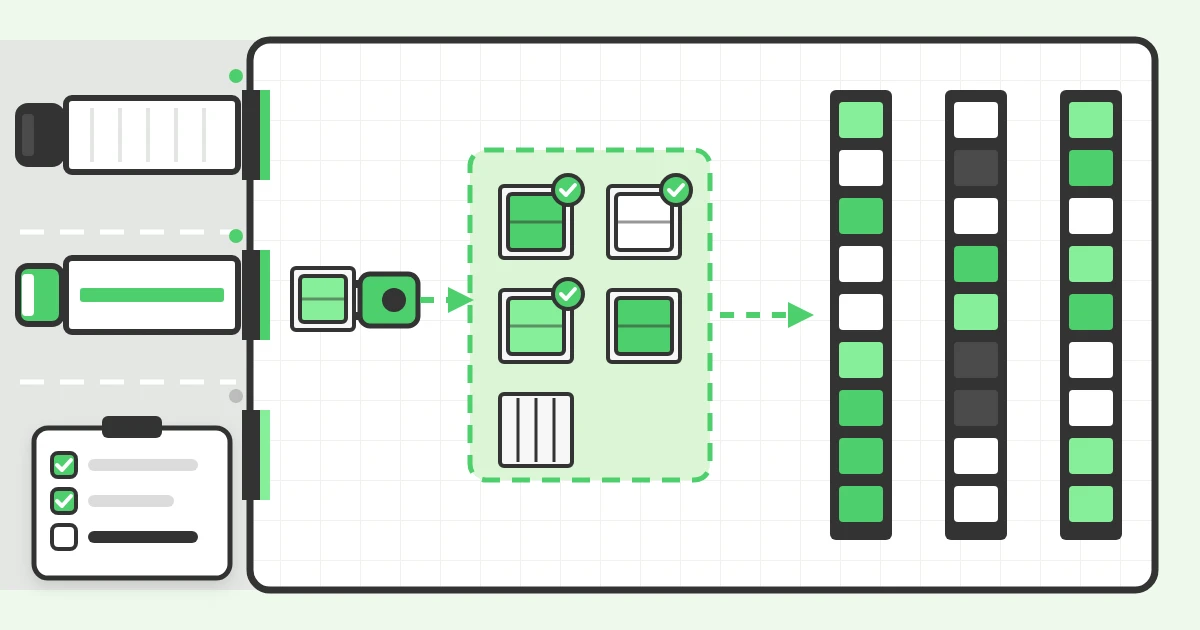
The warehouse receiving process step by step, from booking the truck to putaway. Where receiving breaks, what we recommend and a receiving checklist.

Live load vs drop trailer (drop and hook) from the warehouse side: how each works, detention risk, hidden drop costs and how to schedule both at your dock.
Ready for simpler warehouse scheduling?
Join warehouse teams across the world that replaced spreadsheets and phone calls with simple dock appointment scheduling software.
Start My Free Trial 14-day free trial · No credit card required · Cancel anytime