

A lumper fee is the charge for having a truck unloaded by third-party workers, called lumpers, at the receiving warehouse. It is usually a flat amount per load or per purchase order, often a few hundred dollars, and the driver frequently pays it at the dock and gets reimbursed later. Under federal law, a shipper or receiver that requires lumpers must either provide that help or cover its cost, and coercing a carrier to pay for unloading is unlawful.[1]
We build dock appointment scheduling software, so we see unloading from the warehouse side every day. Most of what you will find on this topic is written for drivers and brokers chasing a reimbursement. This guide covers what shippers and receivers need to know: what the fee pays for, who owes it, where the law draws the line, and how to stop it turning into a dispute on every load.
What is a lumper?
A lumper is a worker, usually employed by a third-party unloading company, who unloads freight from a truck at the receiver's dock. The Eighth Circuit, in a 2011 lumper case, defined it this way: "'Lumping' refers to the loading, and, more often, unloading of goods from a truck upon delivery."[2]
In our experience, lumpers are most common at grocery and foodservice distribution centers, where loads arrive floor-stacked or mixed and have to be broken down, sorted and restacked onto the receiver's own pallets before they go into the racks. A "lumper in a warehouse" is the same person: the warehouse hires an unloading company rather than employing lumpers itself.
What is a lumper fee?
A lumper fee is what the unloading company charges for that work. It is billed per load, per purchase order, per pallet or per case, depending on the receiver's contract with the unloading company, and it is usually collected at the dock before the driver gets the paperwork signed.
Some receivers charge per purchase order rather than per truck, so a truck carrying several orders for the same warehouse can pay several fees.
How much is a lumper fee?
Lumper fees vary by receiver, but most land somewhere between about a hundred and a few hundred dollars per load. No government agency or industry body publishes a survey of lumper rates, so treat any single number you read online as an example, not a benchmark.
What moves the price is the amount of handling, not the distance or the freight value:
| Factor | Lower fee | Higher fee |
|---|---|---|
| How the trailer is loaded | Palletized, one product per pallet | Floor-loaded cases that must be hand-stacked |
| Work on the pallets | Unload as delivered | Sort by product, restack, rewrap or swap onto the receiver's pallets |
| Size of the delivery | A few pallets | A full trailer |
| How the receiver prices it | Flat fee per load | Per pallet or per case on a mixed load |
If you are a shipper, ask each customer you deliver to for their fee schedule. Receivers that use lumpers normally have one, and knowing it before you quote a freight rate is better than finding it later on a carrier's invoice as an extra charge.
Who pays the lumper fee: shipper, receiver or carrier?
Legally, the shipper or receiver that requires the unloading help pays for it. Federal law says that when a shipper or receiver requires a carrier to be assisted with loading or unloading, "the shipper or receiver shall be responsible for providing such assistance or shall compensate the owner or operator for all costs associated with securing and compensating" the people who provide it.[1]
In practice the money moves in a loop, and the carrier is only a temporary step in it:
- The truck arrives and the receiver's unloading company asks for payment before it starts.
- The driver pays, usually with a fuel-card or express-code payment from their carrier or broker.
- The driver gets a lumper receipt and sends it to the carrier or broker.
- The carrier or broker reimburses the driver, if the rate confirmation allows it.
- The carrier or broker bills the fee to the shipper as an accessorial charge.
The rate confirmation (the load agreement between broker and carrier) decides step 4. Some brokers pay the lumper directly and only reimburse a carrier when the confirmation says so; others reimburse against a receipt. Read the lumper line in every rate confirmation you sign or send.
Between shipper and receiver, the law does not pick one. In OOIDA v. Supervalu, the Eighth Circuit held that a driver can only bring a claim against the receiver by showing that neither the shipper nor the receiver reimbursed them.[2] Who absorbs the cost in the end is a commercial question for the sales contract between the two.
Is it legal to make a driver pay for a lumper?
Requiring lumpers is legal. Forcing the carrier to pay for them is not. Federal law makes it unlawful "to coerce or attempt to coerce" an interstate carrier "to employ or pay one or more persons to load or unload" freight, with a narrow exception for activity that is lawful under federal labor law.[1] So a receiver can run an exclusive unloading contract, but the cost has to be covered by the shipper or the receiver, not absorbed by the carrier.
Enforcement is weaker than the wording suggests. The remedy written into the law for a private party is a civil action "for injunctive relief"[1], and in the Supervalu case the drivers' association lost because it could not prove that individual drivers went unreimbursed.[2] That is why the practical fix is contractual, not legal: write who pays into the rate confirmation.
Can a driver refuse the lumper and unload the truck themselves? Some receivers allow it, but not freely. In 2005, Supervalu required drivers who wanted to unload their own trucks to show liability insurance well above the federal minimum, and only relaxed the rule after it was sued.[2] Receivers that allow self-unloading usually set safety training, insurance or equipment conditions first.
This section describes U.S. federal law in general terms. It is not legal advice for a specific dispute.
What is a lumper receipt, and how are lumper fees paid?
A lumper receipt is the unloading company's proof of payment, and without it nobody gets reimbursed. Drivers usually pay with a payment code issued by their carrier or broker, then send the receipt in, and some brokers want it within a day.
A usable receipt shows, at minimum:
- The load number and the bill of lading number
- The unloading company's name and tax ID
- The total amount paid
- What the fee covered (unloading, restacking, pallet exchange)
If you are the receiver, make this easy. Print or email the receipt automatically, put the load and bill of lading numbers on it, and match the amount to your published fee schedule. A missing or vague receipt is how a $200 unloading fee turns into a week of emails between your customer, their carrier and your receiving office.
Why do warehouses use lumpers?
Receivers use lumpers to control who works on their dock and to buy unloading as a service. Supervalu, a grocery wholesaler, moved from freelance lumpers to "professional unloading companies for their exclusive lumping services" in 2005, so that only its contracted lumpers were present at its distribution centers.[2]
Unloading companies are commonly paid per load, so speed pays off for them, and some contracts include a payment back to the receiver.
That last part is what carriers distrust. A fee collected from the driver, partly returned to the receiver, looks like a toll to anyone standing at the dock with a card in hand. If you run a lumper program, a clear fee schedule and receipts that match it are the cheapest way to keep carriers willing to deliver to you.
Lumper fee vs detention: how are they related?
They are separate charges. A lumper fee pays for unloading labor. Detention pays the carrier for time its truck and driver spend waiting beyond the free time. A slow unload can trigger both on the same load.
| Lumper fee | Detention | |
|---|---|---|
| Pays for | Labor to unload (and sometimes sort or restack) the freight | The truck and driver's time waiting beyond the free time |
| Paid to | The unloading company, via the driver or broker | The carrier |
| Priced | Flat per load or PO, or per pallet or case | Per hour, a typical market rate of $50–$100 after two hours of free time |
| Triggered by | The receiver's unloading policy | The clock running past the free time |
| On the shipper's invoice as | Accessorial: lumper or unloading | Accessorial: detention or waiting time |
The link between them is staffing. ATRI's 2024 detention study lists "inadequate staffing at customer facilities" among the causes of detention, and found refrigerated drivers were detained at 56.2% of stops in 2023, against 39.3% across all drivers.[3] When the unloading crew is busy with another truck, the next driver waits, and the shipper gets a detention bill on top of the lumper fee. Read more about how truck detention is calculated and billed.
How can shippers and receivers keep lumper costs predictable?
Most lumper disputes come from surprise: an amount nobody agreed, a receipt that went missing, or an unload that took three hours because six trucks arrived at once. Five habits prevent them.
- Put the lumper terms in the rate confirmation. State whether a lumper is expected, who pays, the maximum amount, and how reimbursement works. This is the document every party will reach for when there is an argument.
- Publish your fee schedule (receivers). One page: price per load or per pallet, what restacking costs, accepted payment methods. Send it with the delivery instructions so shippers can quote it into their freight rates.
- Pay or invoice the lumper directly where you can. A driver paying at the dock and claiming it back is the step where receipts get lost. Direct billing between the unloading company and the shipper, or a digital payment with an automatic receipt, takes the driver out of the loop.
- Book deliveries to match the unloading crew. An unloading crew can only work as many trucks as it has people. When appointments are booked against what the crew can handle, trucks stop queuing for a free crew and overbooked hours stop turning into detention. If carriers book their own slots through a carrier self-booking portal that only shows open capacity, the crew knows the plan and trucks stop arriving in clumps.
- Measure unloading time per truck. Record when each truck arrived, docked and left. Service time tells you whether the fee schedule matches the work, and wait time tells you whether you need more crew at certain hours. Here is how to track dwell time and the other dock scheduling KPIs.
Steps 4 and 5 are what LoadingCalendar does: carriers book a slot on your dock calendar, your team sees every arrival in advance, and the timestamps are recorded for you. It costs a flat $99 per month with unlimited docks, users and carriers. For the waiting-time side of the same problem, see how to reduce detention fees at your warehouse.
Frequently asked questions
Sources
- 49 U.S. Code § 14103, "Loading and unloading motor vehicles": subsection (a) on the shipper's or receiver's duty to provide or pay for unloading assistance; subsection (b) on coercion. 49 U.S. Code § 14704(a)(1): civil action for injunctive relief for violations of section 14103. law.cornell.edu (§ 14103), law.cornell.edu (§ 14704)
- U.S. Court of Appeals for the Eighth Circuit, Owner-Operator Independent Drivers Association v. Supervalu, Inc., No. 09-3577 (11 August 2011): definition of lumping; Supervalu's exclusive unloading contracts from 2005; insurance condition for self-unloading; no claim unless reimbursed by neither shipper nor receiver. govinfo.gov
- American Transportation Research Institute (ATRI), "Costs and Consequences of Truck Driver Detention: A Comprehensive Analysis" (September 2024): detention at 39.3% of all stops and 56.2% for refrigerated drivers in 2023; inadequate staffing at customer facilities listed among causes. truckingresearch.org
No public survey of lumper fee levels exists. The fee ranges in this article are typical market figures, and individual receivers set their own rates. The same applies to the detention rate range.
You might also like
Italy, Spain, Portugal and Hungary set truck waiting time compensation in law. France sets a default; the rest of Europe leaves it to contracts.
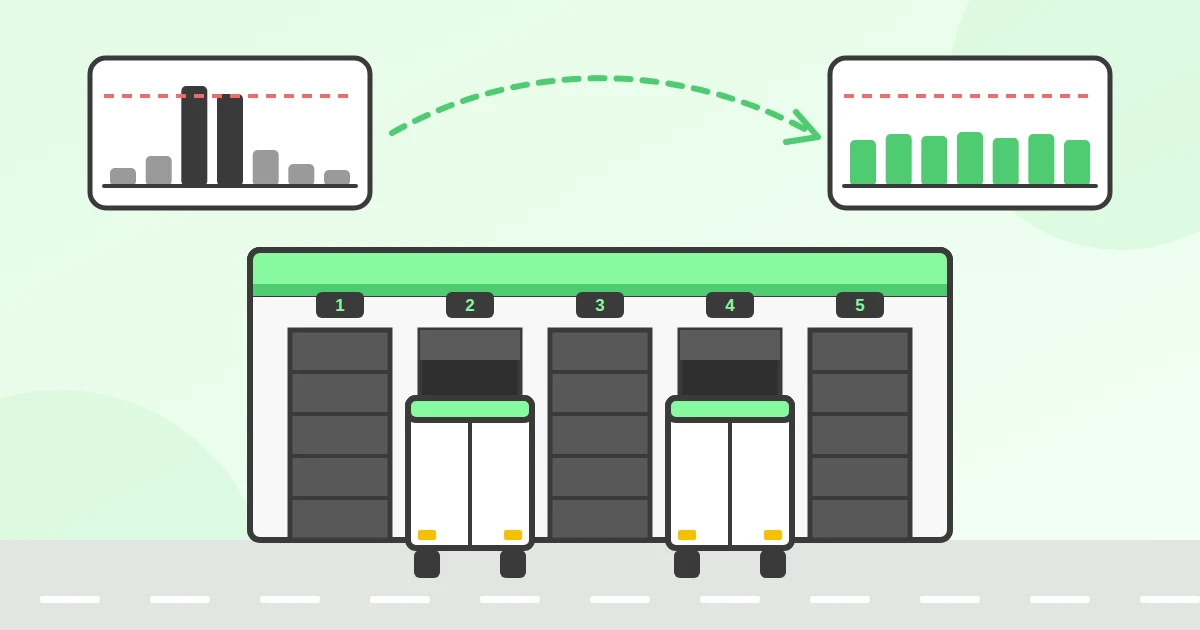
Work out how many loading dock doors you need: the dock planning formula, a free calculator, peak-hour sizing and a queueing table for buffer doors.
The four dock scheduling KPIs that matter: dock utilization rate, truck dwell time, on-time arrival rate and no-show rate. Formulas, a worked example and honest benchmarks.
Ready for simpler warehouse scheduling?
Join warehouse teams across the world that replaced spreadsheets and phone calls with simple dock appointment scheduling software.
Start My Free Trial 14-day free trial · No credit card required · Cancel anytime