Truck Waiting Time Rules in Europe: Free Time, Compensation and Who Pays, Country by Country
There is no EU-wide rule. Four countries set the free time and the hourly rate in law, France sets a default, and the rest of Europe leaves it to the contract. Here is what each country says, checked against the legal texts.


There is no EU-wide law on how long a truck can be kept waiting at a loading dock. Four countries set it in national law. In Italy the carrier gets 90 minutes free, then €100 per hour. In Spain it gets one hour free, then €40 per hour (twice the daily IPREM). Portugal caps the wait at two hours, then pays €12–40 per hour depending on the vehicle. Hungary gives one hour free on domestic transport, then at least HUF 8,636 per hour. France sets free time in a default contract that applies unless you agree otherwise. In the rest of Europe, the contract decides.
These rules are tied to loading and unloading in the country, so foreign shippers and receivers with goods there are likely covered too. If your goods are loaded or delivered in Italy, Spain, Portugal or Hungary, a long wait at the dock now has a price set by law, and whoever has the arrival and departure times on record wins the argument. We checked the national law of every EU and EEA country plus the UK and Switzerland. The table below summarizes the result, and the sections after it quote the legal texts.
Which European countries limit truck waiting time by law?
Italy, Spain, Portugal and Hungary set both the free time and the compensation rate in law (Hungary only for domestic transport). France sets free time in a default contract and leaves the price to the parties. Everywhere else, the law sets no figures.
| Country | Free time | Compensation after free time | Who pays | Legal basis |
|---|---|---|---|---|
| Italy | 90 minutes per operation, from arrival | €100 per hour or part-hour, indexed yearly | Principal and loader, jointly | Art. 6-bis D.Lgs. 286/2005 (since May 2025)[1] |
| Spain | 1 hour | 2 × daily IPREM per hour or part-hour (€40), max 10 hours a day | Shipper (cargador) | Art. 22 Ley 15/2009 (since March 2022)[4] |
| Portugal | 2 hours maximum, from the booked time | €12–40 per hour by vehicle weight and route | Whoever caused the delay (carrier too, if late) | Decreto-Lei 57/2021[7] |
| Hungary | 1 hour after the agreed time, domestic transport only | At least HUF 8,636 per started hour, VAT included | Shipper | Govt. Decree 120/2016, § 8 (since January 2024)[8] |
| France | 15 minutes to 3 hours by load size and appointment (default contract) | Agreed price; no rate in law | Whoever caused the overrun | Code des transports + contrat type général[9] |
| Rest of Europe | "Reasonable" time or per contract | Per contract; otherwise a "reasonable" charge or a damages claim | Per contract | Civil, commercial or transport law with no figures (see below) |
Hungary's rule covers only transport where pickup and delivery are both in Hungary. The rest of Europe is covered country by country further down.
How does Italy's 90-minute rule work?
In Italy, the carrier gets €100 for every hour or part-hour of waiting beyond 90 minutes per loading or unloading operation, counted from the moment the truck arrives. The rule is article 6-bis of Legislative Decree 286/2005, rewritten by Decree-Law 73 of 21 May 2025 and converted, with amendments, by Law 105 of 18 July 2025.[1] Before that, the contract set the free time (at most two hours), and sector-level agreements could set the rule aside.
The principal (committente) and the loader (caricatore) are jointly liable, with a right to recover from whoever caused the delay. No compensation is due if the carrier caused it. The €100 is adjusted every year in line with ISTAT's consumer price index. The same €100 is also due when the loading or unloading itself takes longer than the time written in the contract. Carriers have one year to claim (18 months if the transport starts or ends outside Europe).
A circular from the Ministry of Infrastructure and Transport on 4 November 2025 settled three practical points: the 90 minutes exclude the time spent actually loading or unloading, the full €100 is due even when the overrun is shorter than an hour, and the law no longer provides for contracts to opt out.[2] A ministry circular is guidance, not law, so if you have an opt-out clause in an Italian contract, get local advice before relying on it.
Enforcement is weak so far. The Italian hauliers' association Assotir presented a survey in February 2026 whose headline figure is that 72% of the roughly 70 firms asked receive no waiting compensation.[3] The survey's own breakdown doesn't fully match that figure (among the 20 smallest firms, 55% got nothing), and the sample is small, but the pattern is plausible: many small hauliers don't claim against a customer they depend on.
What are Spain's waiting-time and driver loading rules?
In Spain, if loading or unloading isn't finished within one hour, the carrier can claim stoppage compensation (paralización) from the shipper for the extra time. The first hour is not paid. Royal Decree-Law 3/2022 cut the free time from two hours to one from March 2022.[4]
The rate is twice the daily IPREM (a public reference income index) for every hour or part-hour, for at most 10 hours a day. It rises by 25% on the second day and 50% from the third. The 2023 budget law set the daily IPREM at €20, and it still applies in 2026 because that budget has been rolled over. That makes it €40 per hour and at most €400 for the first day.[5] Contracts can agree a higher amount but not a lower one. The clock runs until the operation is finished, so in Spain the loading time itself counts.
The same reform bans drivers of trucks over 7.5 tonnes from loading or unloading goods, pallets, packaging and roll cages, with exceptions for removals, tankers, tippers and crane trucks, car transporters, distribution to shops and parcel delivery, among others. The ban has applied since 2 September 2022 to every operation in Spain, including those by foreign hauliers.[6]
Breaking the ban is a very serious offense with fines of €4,001–6,000, rising to €6,001–18,000 if the party was already fined for a very serious offense in the previous 12 months. The shipper, consignor, intermediary and consignee can all be held liable, not only the haulier. In practice, a Spanish receiving dock needs its own staff or a contractor to unload, and that has to be planned per time slot.
What does Portugal's two-hour maximum mean?
In Portugal, a truck may wait at most two hours per loading or unloading operation, counted from the agreed or booked time. Beyond that, whoever caused the delay pays compensation for every hour or part-hour, at the table rate for up to 10 hours and 25% more after that. The rule comes from Decree-Law 57/2021, in force since September 2021, and covers both national and international transport loaded or unloaded in Portugal.[7]
Three details matter for a warehouse. The rule works both ways: a carrier that arrives more than two hours late pays the same rate. Bookings must be made 24 hours ahead for national transport, 48 hours for Portugal–Spain and 72 hours for other international transport. Without a booking, the clock starts when the truck is registered in the shipper's or receiver's system. Handling time doesn't count unless the contract says it does. Contracts in force that set different terms are exempt from the two-hour maximum.
The same decree says loading and unloading must be done by a trained worker who is not the driver, with exceptions set by the sector's collective agreement, and that waiting areas must have toilets. The hourly rates are set in the decree's annex:
| Vehicle gross weight | National | Portugal–Spain | Other international |
|---|---|---|---|
| 2.5–3.5 t | €12 | €13 | €14 |
| over 3.5–7.5 t | €15 | €16 | €17 |
| over 7.5–11 t | €18 | €19.50 | €21 |
| over 11–19 t | €24 | €25.50 | €27.50 |
| over 19–26 t | €26 | €28 | €30 |
| over 26–44 t | €30 | €32.50 | €35 |
| over 44 t | €34 | €37 | €40 |
This is compensation for breach of contract, not a fine. Nobody is fined for exceeding two hours; the carrier has to claim the money, within one year.
How does Hungary's waiting-time rule work?
In Hungary, if the carrier is ready at the agreed time but loading or unloading is not finished within one hour, the time beyond that counts as waiting time (állásidő). The fee is at least HUF 8,636 for every started hour, VAT included, and the contract must state the amount. The rule is section 8 of Government Decree 120/2016 on road haulage contracts, rewritten from 28 January 2024, and it covers domestic transport only.[8]
The shipper pays. The party in whose area the wait happened must confirm it in writing; if it doesn't, the carrier can prove the wait with GPS data or other credible evidence. By default the shipper loads and the consignee unloads. If the carrier loads or unloads by agreement, or unloads on the instruction of the party entitled to give instructions, it is owed at least HUF 10,975 an hour for that work.[8]
Does France have a waiting-time rule?
Yes. The law requires agreed loading times and extra pay when they are exceeded, and a default contract supplies the free time if you agree none. The Code des transports requires the parties to agree loading and unloading times in writing before the operation and requires the carrier to keep a document with arrival and departure times, signed by the consignor at loading and the consignee at unloading. That document counts as evidence unless proven otherwise. If the times are exceeded and the carrier is not at fault, the carrier is owed extra pay. These principles cannot be contracted out of.[9]
If there is no written agreement, the general standard contract (contrat type général, Decree 2017-461) applies automatically. Its free time covers the whole stay on site, from identification on arrival until the truck is ready to leave, and depends on load size and on whether an appointment was kept:[9]
| Shipment | Appointment kept | Time window kept or up to 30 min late | Other cases |
|---|---|---|---|
| Under 3 t, under 100 kg and under 20 parcels | 15 min | 15 min | 15 min |
| Other shipments under 3 t | 30 min | 30 min | 30 min |
| 3–10 t and up to 30 m³ | 1 h | 1 h 30 min | 2 h |
| Over 10 t or over 30 m³ | 1 h | 2 h | 3 h |
For shipments of 3 t or more, a truck that arrives early starts the clock only at the appointment time or the start of the agreed window. Waiting beyond the free time is invoiced separately at the agreed price, paid by whoever caused it. There is no hourly rate in law. At a 2022 government round table described in a 2023 inspection report (IGEDD), the hauliers' federation FNTR was the only employers' organization clearly in favor of copying Spain's 2022 rules, chiefly the ban on drivers loading and unloading, while the shippers' association AUTF, backed by the logistics federation TLF, preferred contractual good practice.[10] Note the incentive in the table: for loads of 3 t or more, a warehouse that gives carriers a fixed appointment, and keeps it, gets the shortest free time because it is expected to be ready.
What about the rest of Europe?
Everywhere else, no law sets waiting hours or a rate; the contract or the carrier's standard terms decide. Some countries give the carrier a general right to be paid for unreasonable waiting, and Germany is the clearest example. Section 412 of the Commercial Code (HGB) says the loading time is whatever is reasonable, and waiting beyond it, for reasons outside the carrier's risk, gives the carrier a right to a reasonable standing charge (Standgeld).[11] The market fills the gap with standard terms: the German forwarders' conditions ADSp 2017 allow at most two hours each for loading and unloading a full load on a 40-tonne truck when an arrival time or time window was agreed (or announced by the forwarder and not objected to), less for lighter vehicles.[12]
The most cited German data is old. The federal transport ministry's "Schnittstelle Rampe" study, published in 2013 from a 2012 survey with 793 usable responses, found that 69% of transport firms and 56% of industrial firms reported waits of more than an hour at retail warehouses, while 84% of retailers put waits at retail warehouses under an hour.[13] The study itself says the sample is not statistically representative. The gap between the two sides' views is the part that has not aged.
In the Baltics the rules are thin. In Estonia, the carrier can claim demurrage (seisuraha) only if it was agreed or if loading or unloading takes longer than reasonably necessary for reasons outside the carrier's control.[14] Lithuania's Road Transport Code leaves loading times to the parties and lets them agree a penalty for idle time in writing.[15] Latvia's Road Transport Act makes the shipper pay damages, plus a penalty only if one was agreed.[16] None of the three sets hours or a rate.
Slovenia comes closest to a rule without numbers. Its road carriage contracts act requires loading within a reasonable time. If the shipper causes a delay, the carrier must wait for up to half the agreed loading time again, paid by agreement or at the carrier's tariff, and may then withdraw from the contract. The same waiting rule applies to unloading, after which the carrier may unload the goods itself at the consignee's expense and risk.[17]
The remaining countries have no waiting-time provision in their road transport or carriage law: Austria, Belgium, Bulgaria, Croatia, Cyprus, Czechia, Denmark, Finland, Greece, Iceland, Ireland, Luxembourg, Malta, Norway, Poland, Romania, Slovakia, Sweden, Switzerland and the United Kingdom. The Netherlands is close to the Baltic model: its Civil Code makes the sender pay the carrier's damages if the goods aren't ready at the agreed place and time, whatever the cause, but sets no hours or rate.[18] Austria and Belgium apply CMR to domestic transport too, so the same gap applies at home. In Sweden the standard haulage terms Alltrans 2007 let the carrier charge for waiting it didn't cause and set no free period.[19]
Does EU law or CMR regulate truck waiting time?
No. The CMR Convention, which governs most international road freight in Europe, says nothing about loading time, free time or waiting compensation.[20] No EU regulation or directive sets a waiting limit either, and we found no Commission proposal for one as of October 2026.
EU law touches waiting only from the driver's side. The Road Transport Working Time Directive (2002/15/EC) counts waiting at loading sites as working time unless its likely duration is known in advance.[21] The only EU-level initiative is a voluntary charter on how drivers are treated at loading sites, launched in 2020 by the road transport organization IRU, the European Shippers' Council and the transport workers' federation ETF.[22]
How is waiting time proven?
With timestamps. Every one of these rules counts from a moment: arrival in Italy, the booked time in Portugal, identification on arrival in France. Italy lets the carrier prove arrival with its own GPS data or smart tachograph records if the site gave no instructions on time and place of access.[1] France makes the signed arrival and departure document the default evidence.[9]
That means the carrier will always have a record. The question is whether you have one too. A warehouse that logs arrival, dock-in and departure for every truck, against a booked slot, can check a claim in minutes and dispute the ones that are wrong. The same three timestamps let you measure dwell time and on-time arrival at your docks, so you see a waiting problem before the invoices show it.
What should a warehouse do about these rules?
Treat waiting time as a cost you control. Most long waits start at the dock: trucks arriving in a bunch, a door still occupied, a load not ready. Four steps cover most of it:
- Give every truck a booked slot. Portugal counts from the booked time and France gives the shortest free time when an appointment is kept (for loads of 3 t or more). A carrier booking portal lets carriers pick a free slot themselves instead of calling.
- Record arrival, dock-in and departure in a system. Paper gate logs lose disputes against a carrier's GPS and tachograph data.
- Know your role in each country. In Spain the party that hired the carrier (cargador) pays even if the delay happened at the receiver; in Italy the principal and the loader both owe the money. A 3PL that loads for its clients should check whether it is the loader. If that is you, see dock scheduling for 3PL warehouses.
- Size slots to real handling times. If unloading a full truck takes 75 minutes, a 60-minute slot builds a queue by mid-morning. Our guide on how to reduce detention fees walks through slot length and free-time clauses.
In Spain, add one more: plan who unloads. Drivers of trucks over 7.5 t generally can't unload there, so your staff or a contractor must be at the door when the slot starts.
How do European waiting rules compare to US detention?
In the US no law sets free time or a rate, and there isn't even a standard definition of detention. It is set by contract and usually counted from two hours on site.[23] Italy, Spain and Hungary give less free time than the usual US two hours, and all four countries with a statutory rule fix the rate in law (Hungary as a minimum); in Spain a contract can only raise it. The rest of Europe looks more like the US. For the definitions, see what truck detention is and how it differs from demurrage.
Frequently asked questions
Sources
- Italy, Legislative Decree 21 November 2005 n. 286, article 6-bis, as replaced by article 4 of Decree-Law 21 May 2025 n. 73, converted with amendments by Law 18 July 2025 n. 105: 90 minutes per operation from arrival; €100 per hour or part-hour; joint liability of committente and caricatore; annual ISTAT indexation; proof of arrival by GPS or smart tachograph; limitation period under Civil Code article 2951 (one year, 18 months if the transport starts or ends outside Europe). Article 2(1)(b) of the same decree counts foreign firms doing international transport or cabotage in Italy as carriers. normattiva.it
- Ministero delle Infrastrutture e dei Trasporti, circular n. 13485 on loading and unloading times (4 November 2025), as reported by Shipping Italy: handling time excluded from the 90 minutes; full €100 due for overruns under an hour; opt-out no longer provided for. shippingitaly.it
- Assotir survey on waiting-time compensation (presented 10 February 2026), reported by TrasportoEuropa: headline figure of 72% of roughly 70 surveyed firms receiving no compensation. trasportoeuropa.it
- Spain, Ley 15/2009 del contrato de transporte terrestre de mercancías, article 22, as amended by Real Decreto-ley 3/2022 (consolidated text, Boletín Oficial del Estado): one hour free; 2 × daily IPREM per hour or part-hour; maximum 10 hours a day; only a higher amount can be agreed; article 79: claims expire after one year. boe.es
- Spain, Ley 31/2022 de Presupuestos Generales del Estado para el año 2023, additional provision 90: daily IPREM of €20, set for 2023 and still applicable in October 2026 because the 2023 budget has been rolled over; the public employment service SEPE lists the same figure. boe.es, sepe.es
- Spain, Ley 16/1987 de Ordenación de los Transportes Terrestres, additional provision 13 (driver loading ban for vehicles over 7.5 t, added by Real Decreto-ley 3/2022), article 140.41 (the offense) and article 143 (fines of €4,001–6,000 and €6,001–18,000). boe.es
- Portugal, Decreto-Lei n.º 57/2021 of 13 July 2021 (Diário da República, 1.ª série, n.º 134), articles 23.º-A to 23.º-I and annex: two-hour maximum wait; booking notice; compensation rates by vehicle weight, for up to 10 hours and 25% more after that; driver loading rules. diariodarepublica.pt
- Hungary, Government Decree 120/2016 (VI. 7.) on road haulage contracts, sections 3, 7 and 8, as amended by Government Decree 686/2023 (XII. 29.) from 28 January 2024: one hour after the agreed time; waiting fee at least HUF 8,636 per started hour; loading fee at least HUF 10,975 per hour. njt.jog.gov.hu
- France, Code des transports, articles L3222-4 to L3222-9, and the contrat type général (annex II to article D3222-1, created by Décret n° 2017-461 of 31 March 2017, as amended), articles 2.5, 11 and 18.2. Code des transports, contrat type général (legifrance.gouv.fr)
- Inspection générale de l'environnement et du développement durable (IGEDD), report n° 014903-01 on loading and unloading conditions in road freight (May 2023). igedd.developpement-durable.gouv.fr
- Germany, Handelsgesetzbuch (HGB), § 412(2)–(3): reasonable loading time; reasonable standing charge (Standgeld) for waiting beyond it for reasons outside the carrier's risk. gesetze-im-internet.de
- Allgemeine Deutsche Spediteurbedingungen (ADSp 2017), clause 11.2: loading and unloading time for full loads when an arrival time or time window was agreed. dslv.org
- hwh Gesellschaft für Transport- und Unternehmensberatung for the Federal Ministry of Transport (BMVBS), "Schnittstelle Rampe" final report (11 April 2013): 793 usable survey responses; 69% of transport firms and 56% of industrial firms report waits over one hour at retail warehouses; 84% of retailers estimate waits at retail warehouses at under one hour. einzelhandel.de
- Estonia, Law of Obligations Act (Võlaõigusseadus), § 779(3): demurrage only if agreed or if loading or unloading exceeds the time reasonably necessary. riigiteataja.ee
- Lithuania, Road Transport Code (Kelių transporto kodeksas), articles 32, 33 and 53: loading times set by agreement; a penalty for idle time may be agreed in writing. e-seimas.lrs.lt
- Latvia, Road Transport Act (Autopārvadājumu likums), articles 11, 15 and 25: the shipper pays damages, and a penalty if one was agreed. likumi.lv
- Slovenia, Road Carriage Contracts Act (Zakon o prevoznih pogodbah v cestnem prometu, ZPPCP-1), Uradni list RS 126/2003, articles 34–36 and 68: reasonable loading time; extra time of up to half the agreed loading time, paid by agreement or at the carrier's tariff; after extra unloading time the carrier may unload at the consignee's expense and risk. uradni-list.si
- Netherlands, Civil Code (Burgerlijk Wetboek), Book 8, article 8:1110: the sender compensates the carrier's damage if the goods are not at its disposal at the agreed place and time, whatever the cause. wetten.overheid.nl
- Sveriges Åkeriföretag, Alltrans 2007 general conditions, clause 6.1: waiting time. akeri.se
- Convention on the Contract for the International Carriage of Goods by Road (CMR), Geneva, 19 May 1956, United Nations Treaty Series vol. 399; article 32: claims expire after one year (three years for wilful misconduct). treaties.un.org
- Directive 2002/15/EC on the organisation of the working time of persons performing mobile road transport activities, article 3(a) and (b). eur-lex.europa.eu
- IRU, European Shippers' Council and ETF, joint charter on driver treatment at loading sites (25 November 2020). iru.org
- Federal Motor Carrier Safety Administration, notice on driver detention data collection, Federal Register Vol. 88 No. 163 (24 August 2023): no standard definition of detention; dwell time over two hours typically used to define when detention occurs. govinfo.gov
This article summarizes legal texts as of October 2026 and is not legal advice. Italy's €100 is indexed yearly and Spain's rate follows the IPREM, so check the current figure before you invoice or dispute a claim.
You might also like
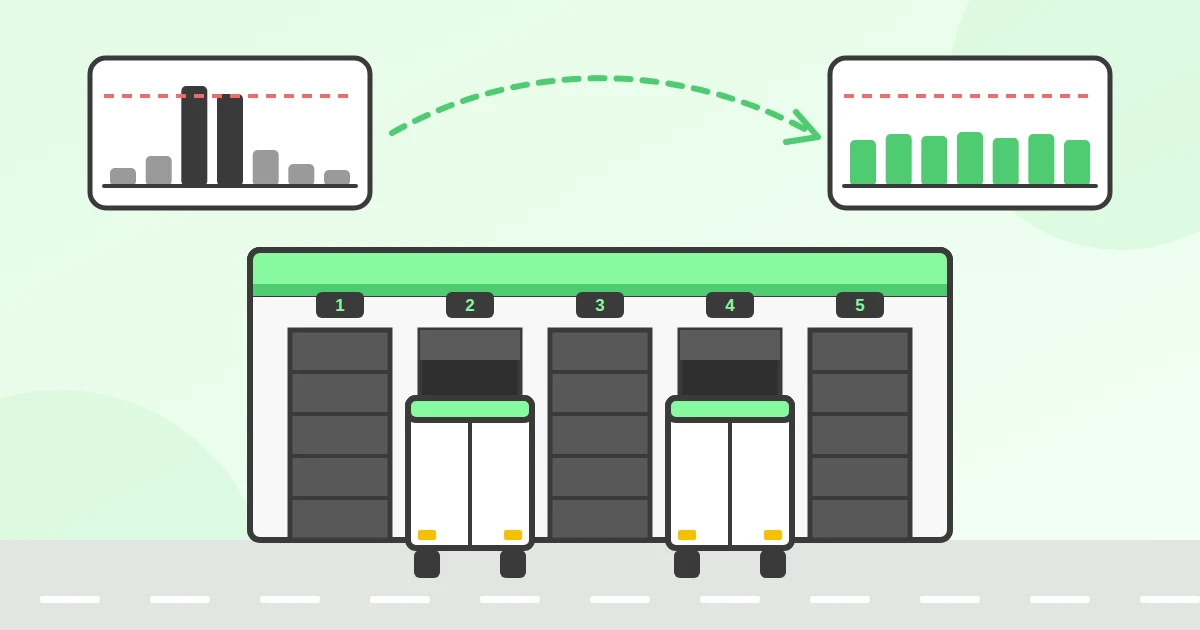
Work out how many loading dock doors you need: the dock planning formula, a free calculator, peak-hour sizing and a queueing table for buffer doors.
The four dock scheduling KPIs that matter: dock utilization rate, truck dwell time, on-time arrival rate and no-show rate. Formulas, a worked example and honest benchmarks.

OTIF (On Time In Full) is the share of orders delivered complete and within the agreed window. Formula, worked example, benchmarks and how to measure it.
Ready for simpler warehouse scheduling?
Join warehouse teams across the world that replaced spreadsheets and phone calls with simple dock appointment scheduling software.
Start My Free Trial 14-day free trial · No credit card required · Cancel anytime